AI Screen Time for Kids: Guidelines, Risks, and Smart Strategies for Every Age
Table of Contents
AI Screen Time for Kids: Guidelines, Risks, and Smart Strategies for Every Age
Last updated: April 2026 | Reviewed by a child development specialist
Your child isn’t just watching a screen anymore — the screen is talking back. AI is reshaping kids’ screen time in ways most parents didn’t see coming. Between AI chatbots that hold full conversations, adaptive learning apps that adjust to your child’s pace, and smart devices that respond to voice commands, the line between passive consumption and active digital interaction has blurred entirely. Understanding how AI affects kids’ screen time is no longer optional for families — it’s essential.
This guide breaks down everything you need to know about AI screen time for kids: how much they’re really getting, what it’s doing to their health, how AI chatbots are changing the game, and exactly what you can do about it — starting today.
How Much Screen Time Are Kids Actually Getting?
Before we can talk about AI’s role, let’s look at the baseline. The numbers are striking.
According to the Centers for Disease Control and Prevention (CDC), the average daily screen time for children — excluding schoolwork — breaks down like this:
| Age Group | Average Daily Screen Time |
|---|---|
| 8–10 years old | 6 hours |
| 11–14 years old | 9 hours |
| 15–18 years old | 7.5 hours |
Those figures don’t include the hours kids spend on screens for homework, virtual classes, or school-issued devices. When you add that in, many children are spending the majority of their waking hours in front of a screen.
And the trend is accelerating. Common Sense Media reports that teens’ daily media use has climbed steadily since 2019, driven by earlier smartphone access, the lasting effects of pandemic-era remote learning, and a new factor that wasn’t part of the conversation even two years ago: AI-powered apps designed to keep kids engaged longer.
AI chatbots and interactive tools don’t just occupy time — they hold attention differently. Unlike a video your child might click away from, an AI chatbot responds, adapts, and keeps the conversation going. That’s a fundamental shift in how children interact with screens, and it’s one reason screen time totals are climbing even as parents try to set limits.
The Health Effects of Too Much Screen Time
Research consistently links excessive screen time to a range of health concerns in children, spanning physical, mental, and social development.
Physical health risks include increased rates of childhood obesity, chronic eye strain, poor posture, and disrupted sleep patterns. The blue light emitted by screens suppresses melatonin production, making it harder for children to fall asleep — and the American Academy of Pediatrics (AAP) notes that screen use within two hours of bedtime significantly reduces sleep quality.
Mental health impacts are equally concerning. Multiple studies have found associations between high screen time and elevated rates of anxiety, depression, and behavioral issues in children. A 2023 meta-analysis of 132 long-term studies confirmed that more screen time is linked to slightly more emotional and social difficulties across age groups.
Social development suffers too. As one pediatrician put it: “You don’t have to be patient with a screen. It’s instant gratification. But you do need patience when you’re talking to someone in person.” Children who spend more time on screens and less time in face-to-face interactions often struggle with turn-taking, active listening, and reading social cues — skills that form the foundation of healthy relationships later in life.
The key takeaway: It’s not just about how long kids are on screens. It’s about what that screen time is replacing — sleep, movement, play, and human connection.
Recommended Screen Time Limits by Age
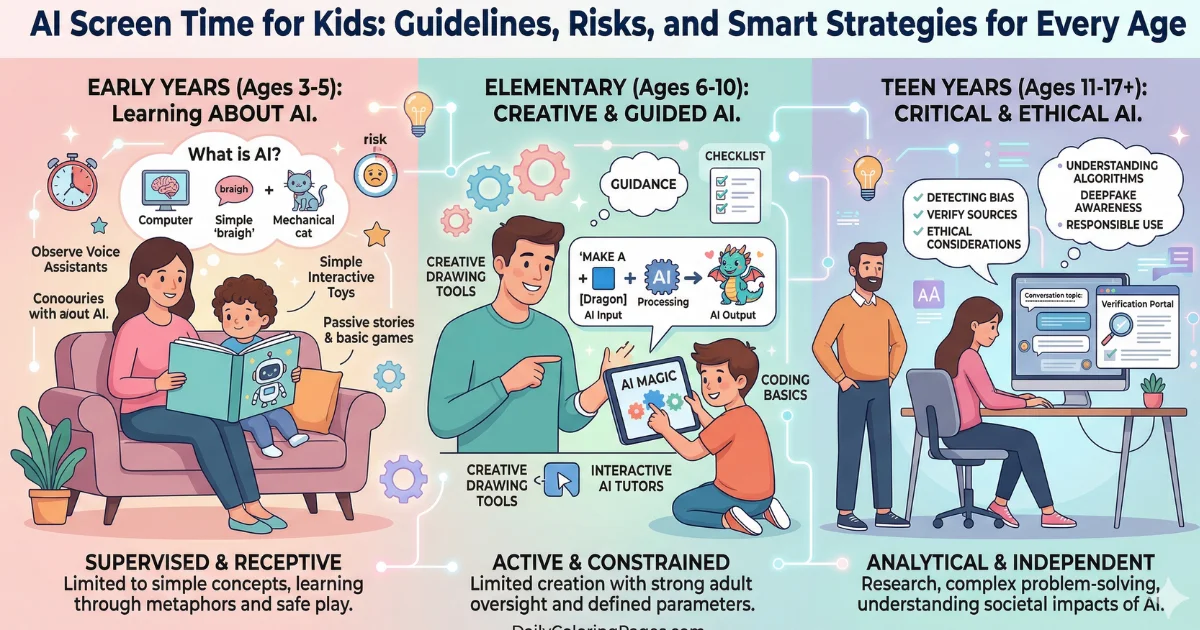
The AAP and the World Health Organization (WHO) provide general guidelines, but in 2026, those guidelines need an AI-specific layer. Here’s an updated framework:
| Age Group | Recommended Daily Limit | AI-Specific Guidance |
|---|---|---|
| Under 2 | Zero screen time (except video calls) | No AI apps or voice assistants used as engagement tools |
| 2–5 | 1 hour max, co-viewed with a parent | AI educational apps only with a parent actively present |
| 5–12 | 2 hours max (non-school use) | Monitor all AI chatbot access; enable parental controls |
| 13–17 | Negotiate limits; prioritize content quality | Discuss AI chatbot boundaries openly; teach critical evaluation of AI responses |
The important shift here is moving beyond “how many hours” toward “what kind of engagement.” Two hours of using an AI tutor to practice math is a very different experience from two hours of unmonitored conversation with an AI companion chatbot. Parents need to evaluate both duration and quality.
How AI Is Changing the Nature of Kids’ Screen Time
This is where the conversation gets genuinely new. AI isn’t just another app on the tablet — it’s fundamentally altering the relationship children have with their devices. Here’s how.
AI Chatbots: A New Kind of Screen Time
AI chatbots and children’s screen time are colliding in ways that catch many families off guard. Tools like ChatGPT, Character.AI, and various child-oriented AI companions are becoming part of everyday digital life for kids. Recent research from Common Sense Media found that roughly 70% of teens have used at least one generative AI tool, and a growing number of children under 13 are interacting with AI chatbots regularly.
Unlike passive content like videos or games, AI chatbots respond directly to a child’s ideas, questions, and emotions. For many kids, this makes the interaction feel personal — even intimate. That’s where the risk lies. Children, especially younger ones, may struggle to understand that an AI chatbot isn’t a real friend. It doesn’t genuinely care. It’s designed to keep them engaged.
The warning signs of unhealthy AI chatbot use include:
- Preferring chatbot conversations over spending time with friends or family
- Becoming withdrawn, secretive, or irritable about device use
- Using an AI chatbot as a primary emotional outlet
- Declining sleep quality due to late-night AI interactions
- Getting upset or anxious when access is restricted
If you notice these patterns, it’s time to step in — not with punishment, but with conversation and new boundaries.
AI as an Educational Tool
Not all AI screen time is cause for concern. AI-powered educational platforms — adaptive math tutors, language learning bots, personalized reading coaches — can be genuinely valuable. They offer instant feedback, adjust difficulty in real time, and make learning accessible to children who might struggle in traditional settings.
The key is using these tools as supplements, not substitutes. When a child uses AI to understand a concept and then practices it independently, that’s productive. When a child copies AI-generated answers into their homework without thinking, that’s a habit worth correcting early.
AI as a Screen Time Management Tool
Here’s the twist many parents don’t expect: AI can also help manage screen time. A study from Fudan University tracked over 6,700 children using AI-enhanced tablets that monitored posture, viewing distance, and ambient lighting during screen use. When AI-based alerts were triggered, 65% of children corrected their viewing distance and 86% improved their posture.
Consumer-facing apps are catching up, offering AI-powered features that remind kids to take breaks, flag extended sessions, and report usage patterns to parents. It’s a bit paradoxical — using AI on a screen to reduce the harms of screens — but the early data suggests it works.
A Parent’s Action Plan: 7 Steps to Take Right Now
Knowledge without action doesn’t change anything. Here’s what you can do this week:
- Audit what’s actually happening. Don’t just count hours. Spend a week observing what your child does on screens — which apps, which AI tools, how they engage.
- Set age-appropriate AI boundaries. Decide which AI tools are allowed, and under what conditions. A 7-year-old using an AI reading tutor with a parent nearby is very different from a 7-year-old chatting unsupervised with an AI companion.
- Explore AI together. Sit down with your child and try the AI tools they use. Ask what they like about them. This builds trust and gives you firsthand understanding.
- Create a Family AI & Media Plan. The AAP offers a free Family Media Plan template at HealthyChildren.org. Adapt it to include specific rules for AI chatbots and AI-powered apps.
- Enforce screen-free zones. No devices in bedrooms. No screens during meals. No AI chatbot access after a set evening time.
- Replace, don’t just remove. Cutting screen time without offering alternatives breeds resentment. Fill the gap with outdoor play, reading, sports, art, or family activities.
- Revisit the rules regularly. AI technology evolves fast. What’s appropriate for your child today may need adjusting in six months. Keep the conversation open and ongoing.
Frequently Asked Questions
Is AI screen time better or worse than regular screen time? It depends entirely on the type of interaction. Active learning with an AI tutor can be more beneficial than passive video watching. But emotionally dependent relationships with AI chatbots carry unique risks that traditional screen time doesn’t.
At what age should kids use AI chatbots? Most child development experts recommend no unsupervised AI chatbot use before age 13. For younger children, AI-based educational tools should only be used with a parent present and engaged.
Can AI actually help reduce screen time? Yes. AI-powered monitoring tools can alert children about posture, viewing distance, and session length. Studies show these alerts meaningfully change behavior, particularly in school-age children.
How do I talk to my child about AI? Start with curiosity, not fear. Ask what they use, what they enjoy, and what surprised them. Frame AI as a powerful tool — not a friend, not an authority — and build their critical thinking about what AI says and does.
The Bottom Line
AI screen time for kids isn’t a single issue with a simple answer. It’s a set of overlapping challenges — health, safety, education, emotional development — that parents now need to navigate with new tools and new awareness. The screens aren’t going away, and neither is AI. But with clear boundaries, open conversations, and a willingness to stay engaged with what your child is actually doing on their devices, you can help them build a healthy, balanced relationship with this technology.
The most important screen time strategy hasn’t changed: be present. The screens are smarter now. Your involvement still matters more.
Looking for more? Explore our guides on [helping kids build healthy digital habits], [AI safety tips for families], and [age-appropriate tech tools for learning].