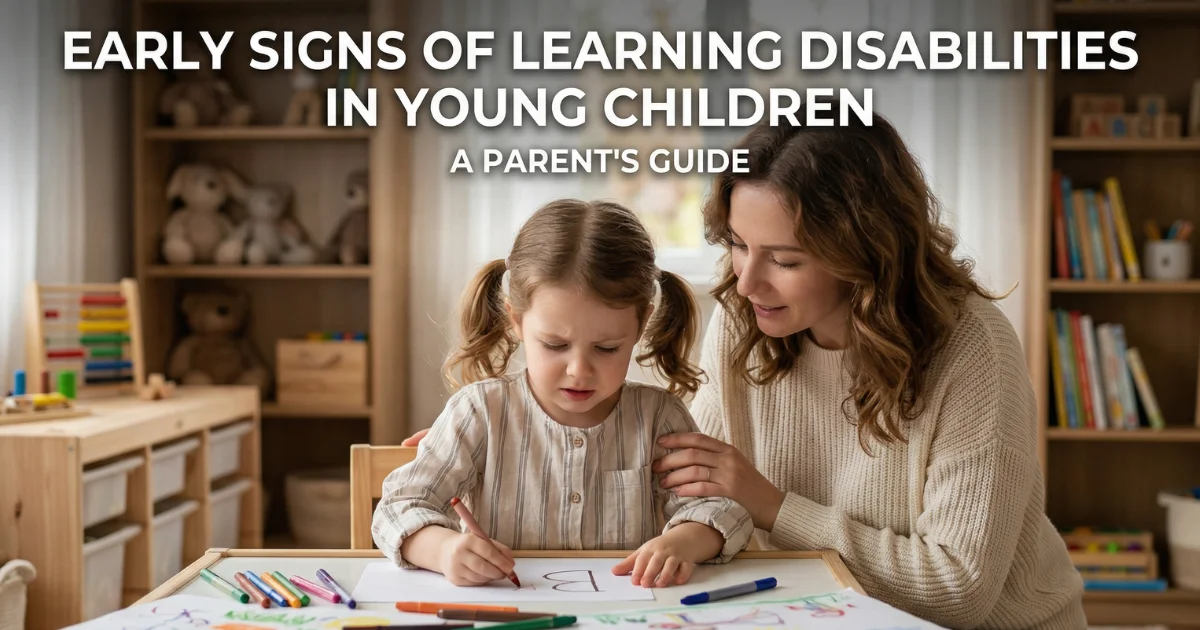
Early Signs of Learning Disabilities in Young Children: A Parent’s Guide
Table of Contents
Early Signs of Learning Disabilities in Young Children: A Parent’s Guide
Meta Description: Trust your parental intuition. Discover the early signs of learning disabilities in preschoolers and young children, and learn the exact steps to take to support your child’s educational journey.
As parents, we naturally compare our children’s progress to the milestones listed in parenting books and pediatrician charts. We celebrate their first words, their first steps, and their first scribbles. However, when a child consistently struggles to grasp concepts that seem to come easily to their peers, it can trigger a wave of anxiety.
You might notice that your preschooler has a hard time remembering the alphabet, or your kindergartener becomes incredibly frustrated when trying to hold a pencil. Is it just a phase, or could it be a sign of a learning disability?
Early detection is one of the most powerful tools a parent has. Understanding the early warning signs of learning disabilities (LDs) allows you to seek the right support before your child’s confidence takes a hit. Here is a comprehensive guide to recognizing the signs and knowing what steps to take next.
What Exactly is a Learning Disability?
First and foremost, it is crucial to understand what a learning disability is not. A learning disability is not a reflection of a child’s intelligence, laziness, or lack of effort. In fact, most children with learning disabilities have average or above-average intelligence.
A learning disability is a neurological difference in how the brain processes, stores, or responds to information. It creates a gap between a child’s true potential and their actual academic performance. Because these are “invisible disabilities,” they often go unnoticed until the academic demands of school increase.
Early Signs in Preschoolers (Ages 3 to 5)
While formal diagnoses are rarely made before first grade, the foundational skills required for reading, writing, and math begin developing much earlier. Here are the red flags to watch for during the preschool years:
1. Language and Speech Challenges
- Difficulty Rhyming: Struggling to recognize or produce simple rhymes (like cat/bat or sun/fun). Rhyming is a critical precursor to phonemic awareness.
- Pronunciation Issues: Consistently mispronouncing words past the age where it is developmentally appropriate (e.g., saying “aminal” instead of “animal” or leaving off the beginning of words).
- Vocabulary Retrieval: Knowing what an object is but struggling to find the right word to name it, often using vague terms like “that thing” or “the stuff.”
2. Cognitive and Memory Struggles
- Trouble Memorizing Routines: Finding it exceptionally difficult to learn the days of the week, the alphabet, colors, or numbers despite repeated exposure.
- Difficulty Following Directions: Struggling to follow multi-step instructions (e.g., “Go to your room, get your shoes, and bring them to the kitchen”).
3. Fine Motor Skill Delays
- Awkward Grip: Having a hard time holding a crayon, marker, or spoon correctly compared to their peers.
- Trouble with Fastenings: Struggling with zippers, buttons, or tying shoes well beyond the typical age of mastery.
Early Signs in Early Elementary (Ages 5 to 7)
As children enter kindergarten and first grade, the signs often become more apparent as they are introduced to formal reading and math instruction.
1. Reading and Writing (Dyslexia and Dysgraphia)
- Connecting Letters to Sounds: Finding it incredibly difficult to understand that the letter “B” makes the “buh” sound.
- Blending Sounds: Struggling to blend individual sounds together to form a word (e.g., sounding out c-a-t but being unable to say “cat”).
- Letter Reversals: While confusing “b” and “d” is normal up to age 7, a persistent inability to write letters in the correct direction or frequently writing words backward can be a red flag.
- Messy Handwriting: Extremely labored, illegible handwriting or a severe aversion to drawing and coloring.
2. Math Concepts (Dyscalculia)
- Number Sense: Failing to connect the number symbol “3” to the concept of three physical objects.
- Counting Difficulties: Frequently losing their place while counting objects or struggling to count backward.
Conditions Often Mistaken for Learning Disabilities
Before jumping to conclusions, it is important to rule out other factors that can mimic the signs of a learning disability:
- Vision and Hearing Problems: A child who cannot see the board or hear the teacher clearly will naturally fall behind. Always start with comprehensive vision and hearing exams.
- ADHD (Attention-Deficit/Hyperactivity Disorder): ADHD affects focus and executive function, making it hard to sit still and complete tasks. While ADHD is not a learning disability, it very frequently co-occurs with them.
- Anxiety: Severe anxiety can cause a child’s mind to go blank, making it appear as though they do not understand the material.
Actionable Steps: What to Do If You Suspect an LD
If your parental intuition is sounding an alarm, do not ignore it. Here is the exact roadmap to advocate for your child:
- Document Everything: Keep a journal of your observations. Note specific examples of what your child struggles with, how long tasks take them, and their emotional reactions to schoolwork.
- Meet with the Teacher: Schedule a meeting with your child’s preschool or elementary teacher. Ask open-ended questions like, “How does my child compare to peers in following directions?” or “What do you notice when they try to sound out words?”
- Consult Your Pediatrician: Bring your documentation to your child’s doctor to rule out physical issues like hearing or vision impairments.
- Request a Formal Evaluation: If your child is in the public school system (in countries like the US or Canada), you have the legal right to request a free, comprehensive evaluation in writing. This process will determine if your child qualifies for an Individualized Education Program (IEP) or a 504 Plan, which provides necessary accommodations.
Frequently Asked Questions (FAQ)
Can a child outgrow a learning disability? No, learning disabilities are lifelong neurological differences. A child does not “outgrow” dyslexia or dyscalculia. However, with early intervention, targeted tutoring, and the right accommodations, they can learn highly effective coping strategies and thrive academically and professionally.
Is dyslexia the only learning disability? No. While dyslexia (difficulty with reading and language processing) is the most common, there are others. Dyscalculia affects math skills, dysgraphia affects writing and fine motor skills, and dyspraxia affects motor coordination.
Will my child be successful if they have a learning disability? Absolutely. Many of the world’s most successful entrepreneurs, scientists, authors, and artists have learning disabilities. Their brains are simply wired to think outside the box. The key to their success is early identification, proper support, and parents who champion their unique strengths.
The Bottom Line
Noticing that your child is struggling can be a painful experience for any parent. However, recognizing these early signs is not a cause for despair; it is a call to action. By acting early, partnering with educators, and seeking professional evaluations, you can ensure your child receives the tools they need to unlock their incredible potential.