7 Powerful Ways Educational Coloring Activities Boost Your Child’s Learning
Table of Contents
7 Powerful Ways Educational Coloring Activities Boost Your Child’s Learning
Educational coloring activities are one of the most underestimated tools in a child’s learning journey. What looks like simple fun with crayons is actually a powerful gateway to developing critical skills — from fine motor coordination to vocabulary building, memory retention, and even emotional intelligence.
Whether you are a parent looking for enriching after-school activities or a teacher searching for creative classroom strategies, turning coloring time into a structured learning experience is easier than you think. This guide walks you through exactly how to do it.
What Are Educational Coloring Activities?
Educational coloring activities go beyond handing a child a coloring book and letting them fill in shapes. They are intentionally designed coloring exercises that connect art with academic content — letters, numbers, geography, science, history, and more.
When a child colors a map of the world while learning country names, or fills in a diagram of the human body while identifying organs, the combination of visual, tactile, and cognitive engagement makes the information stick far longer than reading alone.
Research in educational psychology consistently shows that combining movement (in this case, the physical act of coloring) with academic content reinforces neural pathways and supports deeper learning.
Why Educational Coloring Activities Work So Well

Before diving into specific strategies, it helps to understand why this approach is so effective.
Multi-sensory learning: Coloring engages sight, touch, and fine motor skills simultaneously. This multi-sensory input strengthens memory formation.
Reduced anxiety: The repetitive, calming motion of coloring lowers stress, which in turn opens the brain to absorbing new information more readily.
Sustained focus: Children who struggle to sit through traditional lessons often remain engaged for much longer when coloring is involved.
Creative ownership: When a child colors their own version of a science diagram or history scene, they develop a personal connection to the material.
These benefits make educational coloring activities especially valuable for visual learners, kinesthetic learners, and children with attention challenges.
7 Ways to Turn Coloring into a Learning Activity
1. Use Educational Coloring Activities for Alphabet and Number Recognition
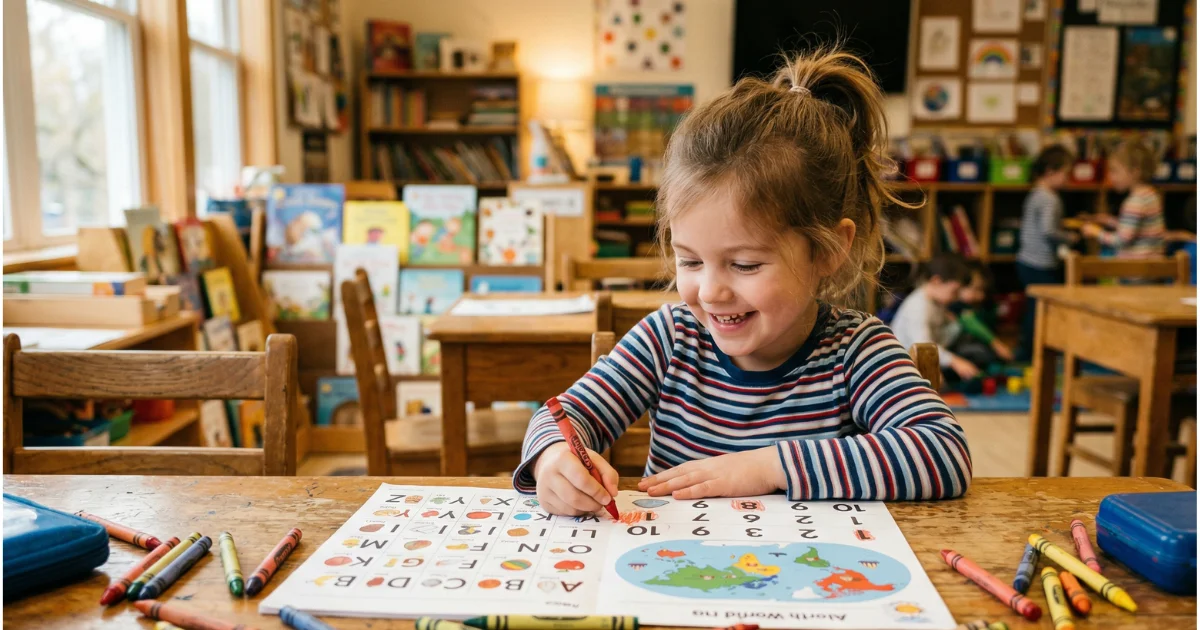
For preschool and kindergarten children, coloring sheets that feature large letters paired with related images — “A is for Alligator,” “B is for Bear” — are a classic introduction to literacy. But you can take it further.
Try these ideas:
- Ask children to color only objects that start with a specific letter.
- Use number-themed coloring sheets where each section is labeled with a number, and children must use that many strokes or that many colors.
- Introduce simple math by asking: “Color three apples red and two apples green. How many apples are there?”
This approach transforms passive coloring into an active learning experience.
2. Bring Geography to Life
Geography coloring maps are among the most effective educational coloring activities for school-age children. A blank world map or country outline becomes a powerful learning tool when paired with intentional tasks.
You can ask children to:
- Color each continent a different color and label it.
- Use warm colors for hot climates and cool colors for cold climates.
- Research a country, then use colors that represent its flag.
This kind of activity builds geographical awareness, research skills, and visual-spatial thinking — all at once.
3. Turn Science Diagrams into Coloring Pages
Science is one of the richest subjects for educational coloring activities. From the layers of the Earth to the lifecycle of a butterfly, science diagrams become far more memorable when children engage with them actively.
Effective science coloring projects include:
- Human body diagrams — color and label organs, bones, or muscles.
- Plant cell vs. animal cell — use specific colors for each organelle to reinforce the differences.
- Food chains and ecosystems — color each level of the chain with a different shade to visualize energy flow.
- Weather systems — color and label cloud types, precipitation forms, or atmospheric layers.
After completing the coloring activity, ask children to explain what they colored in their own words. This verbal reflection deepens understanding significantly.
4. Use Color-Coding for Vocabulary and Language Learning
Educational coloring activities are remarkably effective for language learners — whether children learning to read or students acquiring a second language. Color-coding vocabulary helps the brain categorize and retrieve words more efficiently.
Practical ideas:
- Color nouns blue, verbs red, and adjectives green in a sentence worksheet.
- Use illustrated vocabulary cards where students color the picture and write the word.
- For bilingual learners, create coloring sheets that show an object with its name in two languages.
This technique is especially powerful for English Language Learners (ELL) because it creates a visual anchor for new words.
5. Explore History Through Illustration
History can feel distant and abstract for children — but coloring historical scenes, timelines, or artifacts makes it tangible. When a child carefully colors a scene from Ancient Egypt or a diagram of a medieval castle, they are building a mental image that supports long-term memory.
Ideas for history-based educational coloring activities:
- Color a timeline of important events, using a different color for each era.
- Illustrate historical figures and write one fact about each person.
- Color maps of ancient civilizations or trade routes.
- Recreate historical flags or emblems and research their symbolism.
Pairing these coloring activities with short read-alouds or videos creates a full multi-sensory lesson.
6. Develop Emotional Intelligence with Feelings-Based Coloring
Not all educational coloring activities need to be academic. Social-emotional learning (SEL) is just as important as cognitive development, and coloring can support it beautifully.
Feelings-based coloring activities might include:
- “Color the face to show how you feel today.”
- Coloring pages that depict different scenarios and asking children how the character might feel.
- Creating a personal “emotion color chart” — assigning colors to feelings and explaining why.
These activities build emotional vocabulary, self-awareness, and empathy — critical life skills that support academic success.
7. Gamify Educational Coloring Activities
Adding a game element makes educational coloring activities even more engaging. Simple structures like challenges, timers, or reward systems can dramatically increase motivation.
Try these gamified approaches:
- Color-by-number with a twist: Instead of coloring by number alone, link each number to a correct answer (e.g., “Color section 3 red if 2 + 1 = 3”).
- Coloring bingo: Children color images as they are called out, linking visual recognition to auditory processing.
- Scavenger hunt coloring: Give clues that lead to information, which must be recorded and colored onto a sheet.
- Team coloring projects: Assign sections of a large diagram to different children, encouraging collaboration and discussion.
Tips for Getting the Most from Educational Coloring Activities
To maximize the learning value of your coloring sessions, keep these principles in mind:
Set a clear learning goal before starting. Know what concept you want the child to walk away with. The coloring is the vehicle, not the destination.
Ask open-ended questions during and after. “What did you notice while coloring this?” or “Why did you choose that color?” encourages reflection and deeper engagement.
Connect the activity to real-world contexts. If children are coloring a food pyramid, follow up with a conversation about what they ate for breakfast. Real-world connections make learning meaningful.
Let children make choices. Allowing children to choose their colors (when appropriate) gives them creative agency and increases intrinsic motivation.
Display finished work. Putting completed educational coloring activities on a wall or in a portfolio reinforces pride in learning and creates a reference resource for future review.
Best Educational Coloring Activities by Age Group
Not every activity suits every age. Here is a quick breakdown:
Ages 3–5 (Preschool): Simple shapes, large letters, numbers 1–10, basic animals with labels, emotion faces.
Ages 6–8 (Early Elementary): Maps, simple human body diagrams, plant life cycles, vocabulary coloring cards, basic timelines.
Ages 9–12 (Upper Elementary): Detailed science diagrams, historical scenes, world geography maps, grammar-based color-coding, food chains.
Ages 13+ (Middle School): Complex biological diagrams, chemistry models, historical analysis illustrations, literary theme mapping.
Conclusion: Make Every Coloring Session Count
Educational coloring activities are not just a way to keep children busy — they are a research-backed, highly effective method for making learning stick. When coloring is connected to real academic content and guided with intention, it transforms from a passive pastime into an active learning experience.
Start small. Pick one subject area — geography, science, language arts — and find or create a coloring sheet that aligns with what your child is currently learning. Add a few guiding questions, let them color at their own pace, and finish with a short conversation about what they discovered.
You may be surprised at how much more they retain — and how much they enjoy the process.
Looking for ready-made educational coloring activities? Search for printable learning coloring pages on trusted educational websites, or create your own using free tools like Canva or simple line drawings paired with learning objectives.