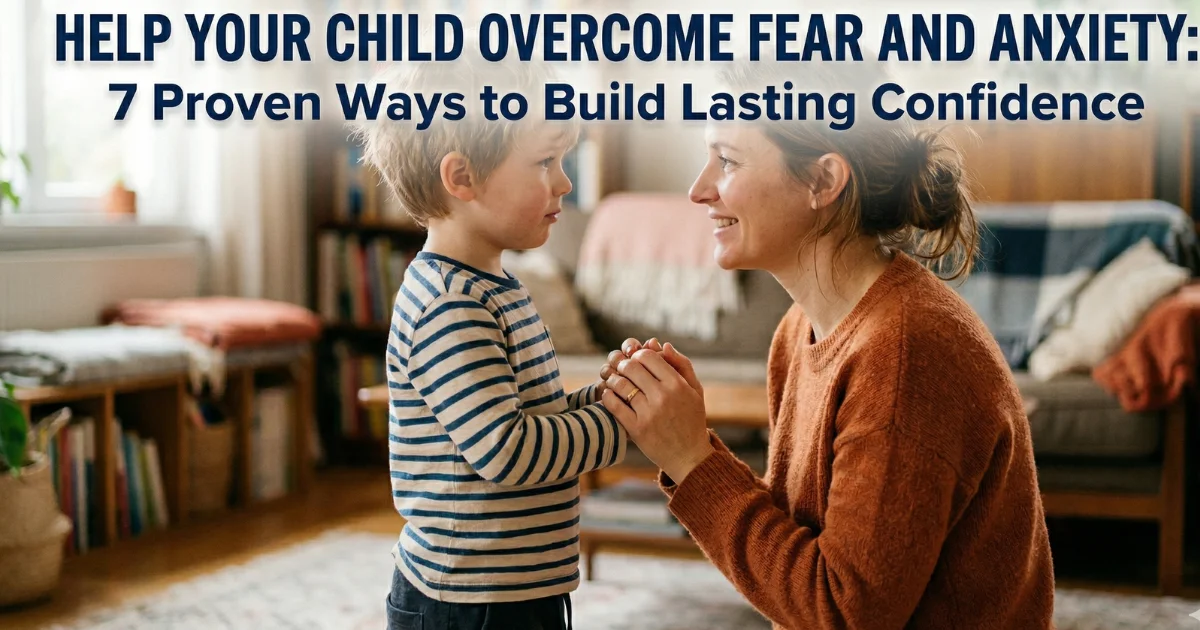
Help Your Child Overcome Fear and Anxiety: 7 Proven Ways to Build Lasting Confidence
Table of Contents
Help Your Child Overcome Fear and Anxiety: 7 Proven Ways to Build Lasting Confidence
Help your child overcome fear and anxiety by understanding what triggers these emotions and learning how to respond with patience and care. Every child experiences fear at some point, whether it’s fear of the dark, separation anxiety, or worry about school. As a parent, your role is not to eliminate fear entirely but to give your child the tools to face it with courage.
Fear and anxiety are natural parts of childhood development. However, when these feelings become overwhelming, they can affect your child’s daily life, relationships, and self-esteem. The good news is that with the right approach, you can guide your child through these difficult emotions and help them grow stronger.
Why Do Children Experience Fear and Anxiety?
Before you can help your child overcome fear and anxiety, it’s important to understand where these feelings come from. Children’s brains are still developing, which means they process emotions differently than adults.
Some common causes of childhood fear and anxiety include:
- Developmental stages: It’s normal for toddlers to fear strangers and for school-age children to worry about performance.
- Life changes: Moving to a new city, starting a new school, or welcoming a new sibling can trigger anxiety.
- Traumatic experiences: Accidents, loss of a loved one, or witnessing conflict can leave lasting emotional effects.
- Learned behavior: Children often mirror the anxiety they see in their parents or caregivers.
- Overstimulation: Too much screen time, busy schedules, or exposure to frightening media can increase anxiety levels.
Understanding the root cause is the first step toward finding the right solution.
1. Create a Safe and Open Environment
One of the most powerful ways to help your child overcome fear and anxiety is to create a home environment where they feel safe to express their emotions. Children need to know that it’s okay to feel scared and that they won’t be judged for it.
Start by actively listening when your child talks about their worries. Avoid dismissing their fears with phrases like “there’s nothing to be scared of” or “just be brave.” Instead, validate their feelings by saying things like “I understand that feels scary” or “It’s okay to feel worried sometimes.”
When children feel heard, they are more likely to open up and less likely to bottle up their emotions.
2. Teach Your Child to Identify Their Emotions
Many children struggle with anxiety simply because they don’t understand what they’re feeling. Teaching your child to name their emotions is a crucial skill that will serve them for life.
Use simple language appropriate for their age. For younger children, you might use emotion charts with faces showing happy, sad, scared, and angry expressions. For older children, encourage them to describe what they feel in their body when they are anxious — such as a racing heart, sweaty palms, or a tight stomach.
Once your child can identify their emotions, they gain a sense of control over them. This awareness alone can reduce the intensity of fear and anxiety.
3. Introduce Breathing and Relaxation Techniques
Breathing exercises are one of the simplest and most effective tools to help your child overcome fear and anxiety in the moment. When anxiety strikes, the body goes into “fight or flight” mode, and deep breathing helps activate the calming response.
Try these kid-friendly techniques:
- Balloon breathing: Ask your child to imagine inflating a balloon in their belly. They breathe in slowly through the nose and out through the mouth.
- 5-finger breathing: Trace the outline of one hand with the finger of the other hand, breathing in on the way up each finger and out on the way down.
- Counting breaths: Simply count to four while breathing in, hold for four counts, and breathe out for four counts.
Practice these techniques during calm moments so your child can use them naturally when anxiety appears.
4. Gradually Expose Your Child to Their Fears
Avoidance is one of the biggest obstacles to overcoming fear. While it’s tempting to protect your child from everything that scares them, this approach actually reinforces the anxiety.
Instead, use gradual exposure. This means gently and slowly introducing your child to the thing they fear, one small step at a time.
For example, if your child is afraid of dogs, you might start by looking at pictures of dogs together, then watching dogs from a distance at a park, and eventually meeting a calm, friendly dog in a controlled setting.
The key is to move at your child’s pace. Never force them into a situation they’re not ready for. Celebrate every small victory along the way.
5. Model Calm and Confident Behavior
Children learn more from what you do than what you say. If you want to help your child overcome fear and anxiety, it’s essential to model healthy emotional responses yourself.
When you face a stressful situation, let your child see how you handle it. Talk through your thought process out loud. For example, you might say, “I’m feeling a little nervous about this presentation, but I’ve prepared well and I know I can do it.”
This teaches your child that everyone experiences fear, and that it’s possible to acknowledge it without letting it take control. Your calm presence is one of the most reassuring things you can offer.
6. Establish Consistent Routines
Predictability is comforting for anxious children. When a child knows what to expect throughout the day, they feel more secure and less likely to be overwhelmed by unexpected situations.
Create consistent daily routines for mornings, mealtimes, homework, and bedtime. A calming bedtime routine is especially important, as anxiety often peaks at night.
Consider including calming activities in the routine such as reading a book together, listening to soft music, or doing a short guided meditation designed for kids.
Routines don’t need to be rigid. The goal is to provide a reliable structure that gives your child a sense of stability.
7. Know When to Seek Professional Help
While many childhood fears are normal and manageable at home, some situations require professional support. It’s important to recognize when your child’s anxiety goes beyond typical developmental fears.
Consider reaching out to a pediatrician or child psychologist if:
- Your child’s anxiety lasts for weeks or months without improvement.
- Fear and anxiety interfere with school, friendships, or family life.
- Your child experiences frequent panic attacks.
- They avoid everyday activities due to worry.
- Sleep, appetite, or behavior changes significantly.
Seeking professional help is not a sign of failure. It’s a proactive step to ensure your child gets the support they need. Therapies like Cognitive Behavioral Therapy (CBT) have been proven highly effective for childhood anxiety.
Help Your Child Overcome Fear and Anxiety with Patience and Love
Every child’s journey with fear and anxiety is unique. There is no one-size-fits-all solution, and progress may be slow at times. What matters most is that your child knows they are not alone and that you are there to support them every step of the way.
By creating a safe environment, teaching emotional awareness, practicing relaxation techniques, and gradually facing fears together, you can help your child overcome fear and anxiety and build the confidence they need to thrive.
Remember, your patience, understanding, and unconditional love are the most powerful tools you have. With time and consistency, your child will learn that fear is not something to run from — it’s something they can face and conquer.