25 Best Screen Free Activities for Kids That They Will Actually Love
Table of Contents
25 Best Screen Free Activities for Kids That They Will Actually Love
Screen free activities for kids are no longer a luxury — they are a necessity. In a world where tablets, smartphones, and television compete for every spare moment of a child’s attention, finding meaningful alternatives has become one of the most important challenges modern parents face.
The good news is that children do not actually need screens to be entertained. In fact, research consistently shows that children who spend more time in screen-free play develop stronger creativity, better social skills, longer attention spans, and healthier bodies. The challenge is simply knowing what to offer — and how to make it appealing enough that children choose it willingly.
This guide gives you 25 of the best screen free activities for kids, organized by category, so you always have something ready no matter the day, the weather, or your child’s mood.
Why Screen Free Activities for Kids Matter More Than Ever
Before diving into the list, it helps to understand what is at stake. The American Academy of Pediatrics recommends limiting recreational screen time for children aged 2 to 5 to one hour per day, and encouraging consistent limits for older children. Yet the average child today spends significantly more time in front of screens than these guidelines suggest.
Excessive screen time has been linked to disrupted sleep, reduced physical activity, delayed language development in toddlers, and increased rates of anxiety and depression in older children and teenagers.
Screen free activities for kids address all of these concerns by replacing passive consumption with active engagement — physical, creative, social, and imaginative.
Creative Screen Free Activities for Kids
1. Drawing and Painting
Few activities are as universally loved and developmentally rich as art. Stock a simple art corner with paper, crayons, watercolors, and colored pencils, and give your child the freedom to create without direction.
For extra engagement, try themed drawing challenges — “draw your dream house,” “invent a new animal,” or “illustrate your favorite story” — to spark imagination and keep things fresh.
2. Playdough and Clay Sculpting
Modeling clay and playdough engage fine motor skills, creativity, and sensory processing all at once. Children can spend hours creating characters, food, animals, and imaginary worlds.
Homemade playdough is inexpensive, non-toxic, and can be made in any color. The act of making it together is itself a wonderful activity.
3. Collage Making
Give children old magazines, newspapers, fabric scraps, stickers, and glue, and let them create collages around any theme — seasons, animals, their favorite foods, or purely abstract designs.
Collage making develops fine motor control, visual thinking, and creative expression without requiring any particular artistic skill.
4. Journaling and Creative Writing
For school-age children who can write, keeping a journal or working on a story is a deeply absorbing and beneficial screen free activity. Provide a nice notebook and a set of colored pens to make it feel special.
Story prompt cards — available in bookshops or easily made at home — can help children who are not sure where to start.
5. DIY Craft Projects
From friendship bracelets and paper origami to building birdhouses and decorating plant pots, hands-on craft projects give children a sense of accomplishment and something tangible to show for their time.
Keep a craft box stocked with basic supplies — tape, scissors, cardboard, string, paint — and introduce a new project each week.
Active Screen Free Activities for Kids
6. Obstacle Courses
Set up an indoor or outdoor obstacle course using furniture, cushions, hula hoops, jump ropes, and whatever else is available. Children love the challenge of beating their own time and can spend hours running the same course repeatedly.
Change the course regularly to keep it fresh and increase the challenge as their skills improve.
7. Dance Parties
Put on music — children’s songs for little ones, or whatever your family loves — and dance. Dancing develops coordination, rhythm, and body awareness while burning energy and boosting mood.
Freeze dance, where children must stop moving when the music stops, adds a game element that keeps things exciting for younger children.
8. Backyard Sports
A ball and an open space are all you need. Kick a football, shoot hoops, play catch, set up a simple cricket game, or invent your own rules. Physical play builds gross motor skills, teamwork, and cardiovascular health.
9. Nature Walks and Scavenger Hunts
Take a walk in the park, neighborhood, or any natural space with a simple scavenger hunt list — find a feather, a smooth stone, something yellow, a spider web, a seed. This turns a simple walk into an adventure.
Nature exposure has been shown to reduce stress and improve attention in children, making it one of the most valuable screen free activities for kids of all ages.
10. Yoga and Mindfulness for Kids
Children’s yoga is playful, accessible, and wonderfully calming. There are many child-friendly yoga sequences available in book form, and practicing together as a family adds a bonding element.
Even five minutes of simple breathing exercises or guided relaxation can help children develop emotional regulation skills that serve them for life.
Imaginative Screen Free Activities for Kids
11. Dress-Up and Role Play
A box of dress-up clothes — hats, scarves, old costumes, fabric pieces — is one of the most enduring play resources you can provide. Children naturally use dramatic play to process experiences, develop empathy, and build narrative thinking.
Let them lead. Whether they are playing house, running a restaurant, or fighting dragons, imaginative role play is serious developmental work.
12. Building with Blocks and Construction Toys
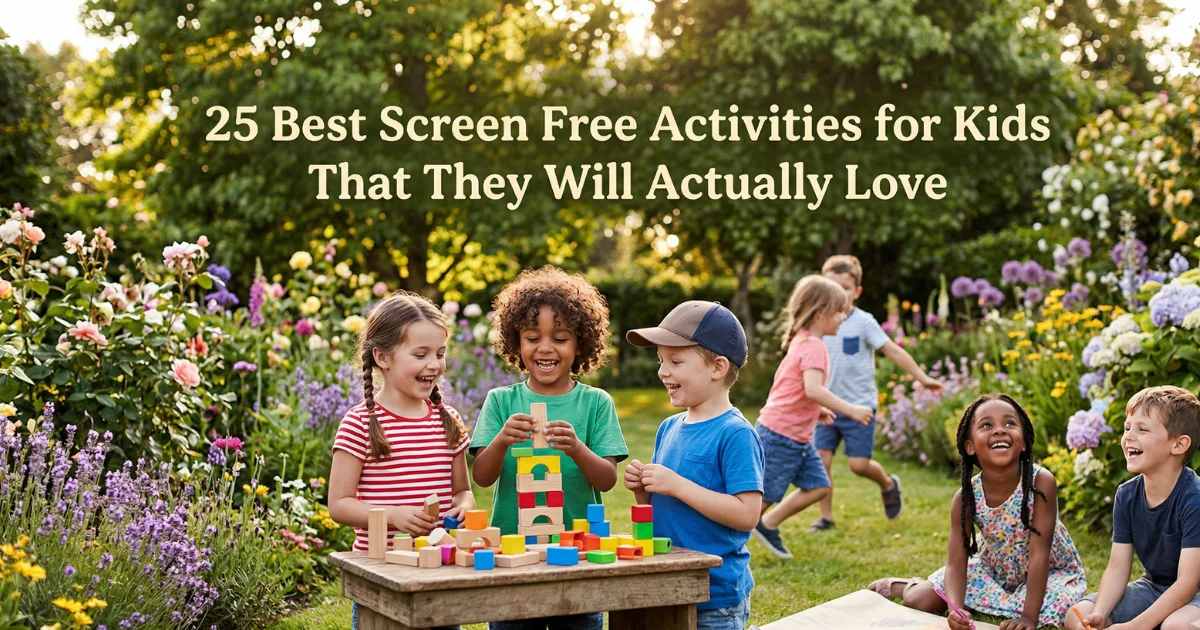
Blocks, LEGO, magnetic tiles, and wooden construction sets engage spatial reasoning, problem-solving, and engineering thinking. These are among the highest-value toys available precisely because they have no single right answer — the possibilities are infinite.
13. Puppet Shows
Make simple puppets from socks, paper bags, or old gloves and put on a show. Children can write their own scripts, design their own characters, and perform for family members. This builds language, creativity, narrative thinking, and confidence.
14. Creating an Imaginary World
Give children a large cardboard box and basic art supplies and ask them to turn it into anything — a spaceship, a castle, a shop, an undersea cave. The process of designing and building their own world is deeply engaging and endlessly extensible.
15. Storytelling Games
Sit together and create a story one sentence at a time, taking turns to add the next line. This simple game builds listening skills, creativity, vocabulary, and the ability to think on one’s feet — all while being genuinely fun for the whole family.
Social Screen Free Activities for Kids
16. Board Games and Card Games
A well-chosen collection of board games and card games provides hours of screen free entertainment while building strategic thinking, turn-taking, emotional regulation, and family connection.
Great options for mixed ages include Uno, Snakes and Ladders, Dobble, Cluedo, and Catan Junior. Introduce one new game every few weeks to keep the collection fresh.
17. Cooking and Baking Together
Involving children in meal preparation is one of the most multi-dimensional screen free activities available. It builds maths skills (measuring), science understanding (what happens when you heat something), life skills, and confidence — and produces something delicious at the end.
Start with simple recipes: pancakes, cookies, homemade pizza dough, or fruit salad.
18. Gardening
Giving a child their own small patch of garden — or even a few pots on a windowsill — to plant, water, and tend connects them to nature, teaches patience, and provides a genuine sense of responsibility and pride.
Sunflowers, radishes, and cherry tomatoes are particularly satisfying for children because they grow quickly and produce visible results.
19. Pen Pals and Letter Writing
Encourage your child to write letters to grandparents, cousins, or friends who live elsewhere. The joy of receiving a handwritten letter in return is something no digital message can replicate — and the practice builds writing skills, empathy, and relationship.
20. Community Helping Projects
Older children especially benefit from being involved in something larger than themselves. This might mean helping at a local food bank, organizing a neighborhood toy collection, or simply helping an elderly neighbor with their garden.
Purposeful contribution builds character, perspective, and self-esteem in ways that passive entertainment simply cannot.
Quiet Screen Free Activities for Kids
21. Reading
Books are perhaps the single most important screen free activity for children. Reading builds vocabulary, comprehension, empathy, imagination, and academic ability across every subject.
Make reading irresistible by letting children choose their own books, visiting the library regularly, and reading aloud together even after children can read independently — shared reading remains bonding and beneficial well into the teenage years.
22. Puzzles
Jigsaw puzzles develop spatial reasoning, patience, persistence, and visual discrimination. They are also wonderfully calming and can be done alone or together.
Keep a range of difficulty levels available and increase the piece count as your child’s skills grow.
23. Learning a Musical Instrument
Learning to play an instrument — even informally, without lessons — builds auditory processing, fine motor skills, mathematical thinking, and emotional expression. A simple recorder, ukulele, or keyboard can open up a world of musical exploration.
24. Science Experiments at Home
Simple science experiments using household materials are endlessly fascinating for curious children. Vinegar and baking soda volcanoes, growing crystals, building a simple circuit, or making a paper bridge that holds weight — these activities build scientific thinking and a love of discovery.
Many excellent children’s science experiment books are available, or a simple online search yields hundreds of ideas using basic kitchen supplies.
25. Mindful Coloring and Zentangle
For older children and teenagers especially, detailed coloring pages and Zentangle-style drawing — filling patterns with intricate repetitive designs — are genuinely meditative and calming. They build focus and fine motor precision while providing a healthy emotional outlet.
How to Make Screen Free Activities for Kids Actually Work
Having a list of activities is one thing — actually getting children to engage with them instead of reaching for a screen is another. Here are a few principles that make the difference:
Reduce friction: Keep art supplies, books, puzzles, and outdoor equipment easily accessible. If everything is packed away in cupboards, children default to screens because they are the easiest option.
Be present at the start: Most children need an adult to initiate a new activity and play alongside them for the first few minutes before becoming independently absorbed. Your presence at the beginning dramatically increases how long they engage.
Avoid filling every moment: Boredom is not the enemy. Children who are allowed to be bored develop the capacity to generate their own entertainment — which is one of the most valuable skills imaginable. Resist the urge to immediately solve boredom with a screen or a structured activity.
Set consistent screen boundaries: Screen free activities thrive when screen time has clear, consistent limits. When children know that screens are available only at certain times, they stop waiting for screen time and genuinely invest in other activities.
Rotate the options: Novelty drives engagement. Rotating which activities are available — bringing out the playdough one week, the craft box the next — keeps things feeling fresh and interesting.
Conclusion: Screen Free Activities for Kids Start With One Good Idea
You do not need to implement all 25 ideas at once. Start with one or two that suit your child’s age and interests, make them easily accessible, and be willing to play alongside them initially.
Screen free activities for kids are not about deprivation — they are about abundance. Abundance of imagination, creativity, connection, movement, and genuine joy. When children discover how engaging the non-digital world can be, screens often become far less magnetic on their own.
The investment you make in building a rich, screen free play environment is one of the most lasting gifts you can give your child — not just for their childhood, but for the kind of adult they will become.
Enjoyed this article? Explore more of our parenting and child development guides for practical advice on raising happy, healthy, and engaged children.