Creativity for kids – 12 Practical Tips to Encourage Creative Thinking at Home
Table of Contents
How to Encourage Creativity in Young Children (12 Practical Tips for Parents)
Creativity for kids is not a talent some children are born with and others are not — it is a capacity that every child possesses and that every parent can nurture starting today.
Creativity is not a talent some children are born with and others are not. It is a capacity that every child possesses and that every parent and teacher can either nurture or accidentally suppress — depending on the environment they create and the messages they send.
The research on creativity in children is remarkably consistent. Children who are given space, materials, time, and freedom to create develop stronger problem solving skills, greater emotional intelligence, higher academic achievement, and more resilient mental health than children who are not. Creativity is not a luxury — it is a fundamental developmental need.
And here is the most reassuring finding of all — you do not need to be creative yourself to raise a creative child. You simply need to understand what creativity needs to thrive and provide it consistently.
These 12 practical tips will show you exactly how to do that.
What Creativity Actually Is — And What It Is Not
Before we dive into the tips it is worth clarifying what we mean by creativity — because many parents have a narrow understanding of the concept that accidentally limits how they support it.
Creativity is not just drawing and painting. It is not just making things. It is not a special gift that only artistic people have.
Creativity is the ability to generate new ideas, make unexpected connections, approach problems from fresh angles, and produce something — an object, an idea, a solution, a story — that did not exist before. It is as relevant to science, mathematics, cooking, and engineering as it is to art and music.
When we talk about encouraging creativity in young children we are talking about nurturing this broad capacity for original thinking — not just teaching children to make pretty pictures.
With that understanding in mind here are the 12 most effective things you can do.
Tip 1 — Provide Open-Ended Materials
The single most important thing you can do to support your child’s creativity is to provide open-ended materials — materials that can be used in multiple ways and that have no predetermined correct outcome.
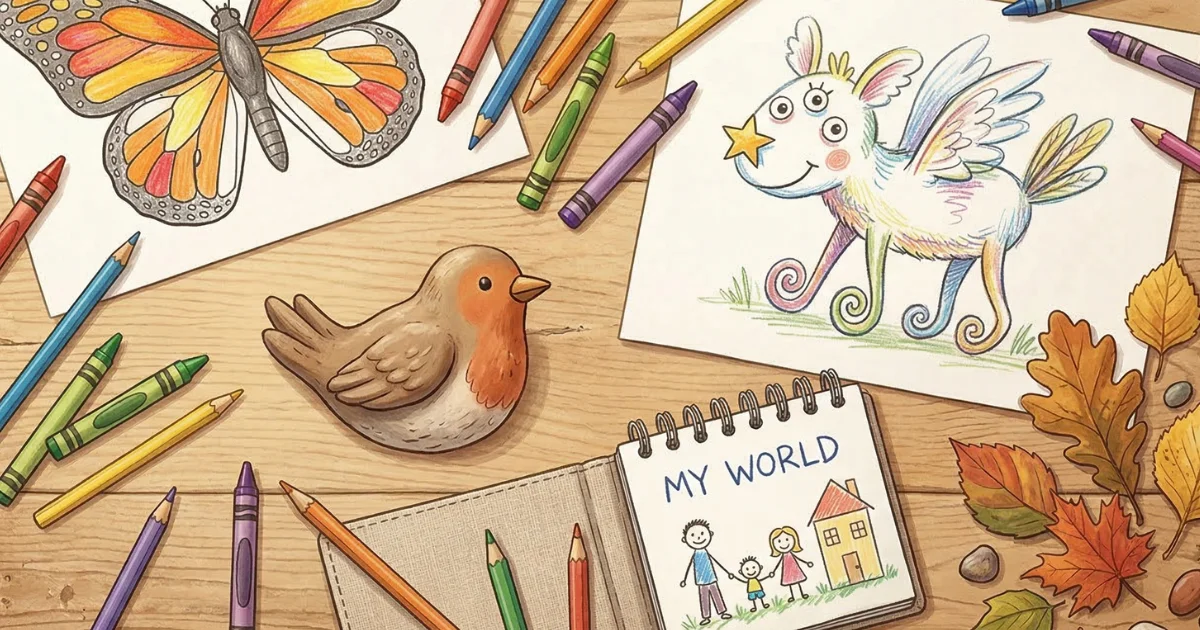
Open-ended materials include things like blank paper, cardboard boxes, fabric scraps, clay, playdough, blocks, natural materials like sticks and stones and leaves, paint, collage materials, and yes — coloring pages that give structure without dictating the outcome.
The opposite of open-ended materials are closed-ended materials — toys and activities that have only one correct way to use them. A puzzle has one correct solution. A paint-by-number has predetermined colors. A coloring page of a character that must be colored in the character’s known colors is more closed than open.
Open-ended materials work because they put the child in the position of the decision maker. There is no right answer to work toward. There is only the child’s imagination, the materials, and the infinite possibilities between them.
Practical tip: Create a simple art supply station accessible to your child at all times stocked with blank paper, colored pencils, crayons, scissors, glue, and a selection of simple coloring pages. Accessibility is key — creativity happens spontaneously and the materials need to be available when the impulse strikes.
Tip 2 — Step Back and Resist Directing
This is the tip that most parents find hardest — and it is arguably the most important one.
When children are creating many parents instinctively want to guide, suggest, correct, and improve. We see a child drawing a purple dog and we say dogs are not purple. We see a child building a structure and we say that will fall down, try it this way. We see a child coloring outside the lines and we redirect them back inside.
Every one of these well-intentioned interventions sends the same message — your creative instinct is wrong and mine is right. Over time children internalize this message and stop trusting their own creative impulses. They begin to ask for permission and approval before making any creative decision. Their creativity is not lost — it is buried under layers of self-doubt installed by the very people who love them most.
The antidote is to step back. Watch. Be genuinely curious about what your child is making rather than anxious about whether they are doing it correctly. Ask open questions — tell me about what you are making, what made you choose that color, what happens next in your picture — rather than offering directions.
Practical tip: When your child is creating set yourself a rule — no suggestions for the first 10 minutes. Simply observe and be present without directing. You will be amazed at what children produce when adults step back.
Tip 3 — Celebrate Process Not Product
In our outcome-focused culture we have a strong habit of evaluating creative work by its finished result. Is it beautiful? Does it look like what it is supposed to look like? Is it as good as what other children make?
This outcome focus is deeply damaging to children’s creativity. It teaches them that the value of creating lies in the finished product rather than in the act of creating itself. Children who are evaluated primarily on outcomes become afraid to experiment, take risks, or make marks they are not sure about — all the behaviors that are actually essential to creativity.
The alternative is to celebrate process. When your child shows you something they have made focus your comments on what they did — the choices they made, the effort they put in, the problem they solved — rather than on how the finished result looks.
Instead of — that is so beautiful — try — I can see you spent a long time on this, tell me about it.
Instead of — that does not look like a horse — try — I love how you chose those colors, what is happening in the picture?
Instead of — that is amazing — try — I noticed you tried something different here, what made you decide to do it that way?
Practical tip: Display your child’s creative work — however it looks. The act of displaying communicates that their work has value regardless of its appearance. A gallery wall of children’s art sends a powerful message about the worth of creative effort.
Tip 4 — Protect Unstructured Time
Modern children’s lives are extraordinarily scheduled. School, homework, extracurricular activities, organized sports, structured playdates — the calendar fills up and genuine free unstructured time becomes scarce.
But unstructured time is precisely when creativity flourishes. When children have nothing scheduled, nothing required, and nothing to do — and no screen to fill the gap — they are forced to generate their own entertainment. And generating your own entertainment is the purest form of creativity there is.
Boredom is not the enemy of childhood. Overscheduling is. The child who learns to transform boredom into imaginative play is developing one of the most valuable skills a human being can have.
Practical tip: Protect at least one hour of completely unstructured time per day in your child’s schedule. No organized activities, no screen time, no parent-directed play. Just time and space and available materials. It may feel uncomfortable at first — for both of you. Persist.
Tip 5 — Read Together Every Day
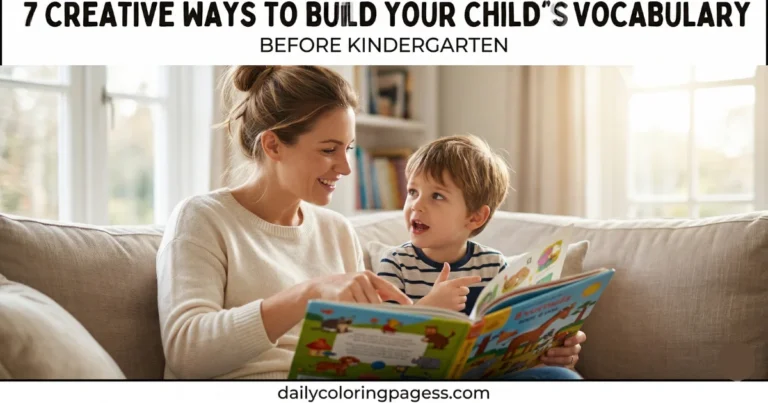
Reading is perhaps the most underrated creativity tool available to parents. Stories expose children to an extraordinary range of characters, worlds, situations, emotions, and ideas that become the raw material of their own imaginative and creative thinking.
Children who are read to regularly have richer vocabularies, more developed imaginative capacities, greater emotional understanding, and more sophisticated storytelling ability than children who are not. All of these are creativity skills.
Beyond the content of the stories the act of reading together models the pleasure of entering an imaginative world — something that is directly transferable to the child’s own creative work.
Practical tip: Read together every day — even for just 15 minutes. Let your child choose books within a curated selection. Ask open questions about the story — what do you think happens next, how do you think the character feels, what would you do if you were in that situation. These questions activate creative thinking about the story.
Tip 6 — Expose Children to Many Different Creative Forms
Creativity is not one thing. Music, dance, theatre, visual art, writing, cooking, gardening, building, crafting — these are all forms of creative expression and different children find their deepest creative engagement in different forms.
Many parents focus exclusively on visual art — drawing and painting — as the primary creative activity for their children. But a child who finds visual art frustrating may be a natural musician, storyteller, dancer, or builder. Exposing children to a wide range of creative forms gives every child the chance to find the medium where their creativity comes most naturally and joyfully alive.
Practical tip: Introduce one new creative form per month. This month make simple musical instruments from household items and explore sound. Next month try simple cooking and recipe experimentation. The month after try movement and dance to different types of music. Breadth of exposure is as important as depth of practice.
Tip 7 — Create a Physical Space for Creativity
The physical environment sends powerful messages about what is valued and what is possible. A home that has a visible, accessible, well-stocked creative space tells children that creativity is important here and that they are free to create here.
This does not need to be a dedicated room or an expensive setup. A corner of the kitchen with a small table, a cup of crayons, a stack of paper and coloring pages, and a tray for messy materials is sufficient. The key factors are accessibility — children can reach everything without adult help — and permission — children know they are free to use the materials without asking every time.
Practical tip: Set up a simple creativity corner this week. Choose a location your child passes frequently. Stock it with the materials most likely to engage your specific child. Make a simple rule — everything in this corner is yours to use freely. Then step back and watch what happens.
Tip 8 — Make Mistakes Visible and Normal
One of the greatest barriers to creativity — in children and adults — is the fear of making mistakes. Children who are afraid to make mistakes do not experiment, do not take creative risks, and do not persist through the inevitable difficulties of the creative process.
The most effective way to reduce your child’s fear of mistakes is to make your own mistakes visible. When you make a mistake in cooking — name it, laugh about it, and problem solve out loud. When you draw something that does not turn out as you intended — say it out loud and keep going. When you try something new and it does not work the first time — model persistence and curiosity rather than frustration.
Children learn how to respond to mistakes primarily by watching how the adults around them respond to their own mistakes. A parent who handles mistakes with lightness and curiosity raises children who handle mistakes with lightness and curiosity — the essential creative mindset.
Practical tip: Use the phrase — that is interesting, let me try something different — when something does not work out as planned. This simple reframe models the creative mindset of curiosity over frustration.
Tip 9 — Ask Creative Questions
The questions adults ask children shape the way children think. Closed questions — what color is that, how many are there, what is the name of this — build factual knowledge. Open creative questions build imaginative and creative thinking.
Creative questions have no single correct answer. They invite speculation, imagination, and original thought. They signal to children that their ideas are interesting and worth exploring.
Examples of creative questions:
- What would happen if gravity worked backwards for one day?
- If you could invent a new animal what would it look like?
- If your bedroom could be any shape what shape would you choose?
- What would you do if you found a tiny door in the wall of your room?
- If colors had sounds what sound would red make?
Practical tip: Ask one creative question per day — at dinner, in the car, at bedtime. There are no wrong answers. Your job is to listen with genuine interest and add your own imaginative responses to the conversation.
Tip 10 — Connect Creativity to the Real World
Children’s creativity deepens significantly when it is connected to real world experiences — a visit to a museum, a walk in nature, a trip to a market, a conversation with an interesting person. Real world experiences provide the raw material that imagination transforms into creative work.
After a walk in the woods give children paper and art materials and ask them to make something inspired by what they saw. After visiting a market ask them to design their own market stall — what would they sell, how would they display it, what would they call it. After a rainstorm go outside together and ask them to describe five things that are different about the world after rain.
Practical tip: Make a simple habit — every time your family has an experience outside the home give your child 15 minutes of creative time afterward to process and respond to what they experienced. The creative work will be richer and more personal than anything produced from imagination alone.
Tip 11 — Limit Passive Consumption
There is an important distinction between creative media consumption and passive media consumption. A child who watches a documentary about ocean animals and then draws an elaborate underwater scene is engaging in creative consumption. A child who watches three hours of entertainment television and then sits blankly staring at a blank page is experiencing the creativity-suppressing effects of passive consumption.
Heavy passive media consumption — particularly fast-paced entertainment content — numbs the creative impulse. Children who consume a great deal of passive entertainment often struggle to generate ideas independently because they have become accustomed to having ideas delivered to them rather than generating them.
Reducing passive consumption does not mean eliminating all screen time. It means being intentional about the type of content children consume and ensuring that creative, active, and imaginative activities significantly outweigh passive viewing in their daily experience.
Practical tip: For every hour of passive screen time ensure at least one hour of creative screen-free activity. This simple ratio makes a measurable difference to children’s creative capacity over time.
Tip 12 — Be Creative Yourself
The most powerful thing you can do to raise a creative child is to be creative yourself — visibly, regularly, and joyfully — in front of your child.
You do not need to be talented. You do not need to produce beautiful work. You simply need to engage in creative activities with genuine pleasure and without self-criticism. Cook something experimental. Draw something even though you think you cannot draw. Plant a garden. Write in a journal. Build something. Sing.
Children who grow up watching adults engage in creative activities with pleasure and freedom internalize the message that creativity is a normal, valued, enjoyable part of adult life — not something you grow out of or something only specially talented people do.
Practical tip: Choose one creative activity you genuinely enjoy — or once enjoyed — and do it regularly where your child can see you. You do not need to involve them. Simply let them observe you creating with pleasure. The message this sends is more powerful than any tip on this list.
Frequently Asked Questions
My child says they are not creative — what should I do? Never agree with this statement. Instead say — everyone is creative in different ways, let us find yours. Then expose your child to a wide range of creative forms — visual art, music, storytelling, building, cooking, movement — until you find the medium where their creativity comes alive most naturally.
How young can I start encouraging creativity? From birth. Even babies respond to color, music, and varied sensory experiences. Simple open-ended sensory play for infants and toddlers — water play, textured materials, simple musical instruments — begins building the creative capacity that becomes richer and more complex as children grow.
Should I enroll my child in art classes? Art classes can be wonderful if the teacher emphasizes process over product, experimentation over technique, and encouragement over evaluation. However structured art classes are not necessary for creative development — a well-stocked home environment and a supportive parent attitude are more important than any class.
What if my child only wants to color the same things over and over? This is completely normal and developmentally appropriate. Children often return to the same creative activity repeatedly because repetition is how they develop mastery and confidence. Do not try to force variety. The confidence built through mastering one activity naturally leads children to experiment with new ones when they are ready.
How do I balance structure and freedom in creative activities? A small amount of structure helps many children — particularly younger ones — engage with creative activities. A simple prompt like draw something that makes you happy or make something using only these three colors provides just enough structure to launch creative engagement without constraining it. Think of structure as the container and freedom as what fills it.
— Lina, Daily Coloring Pages