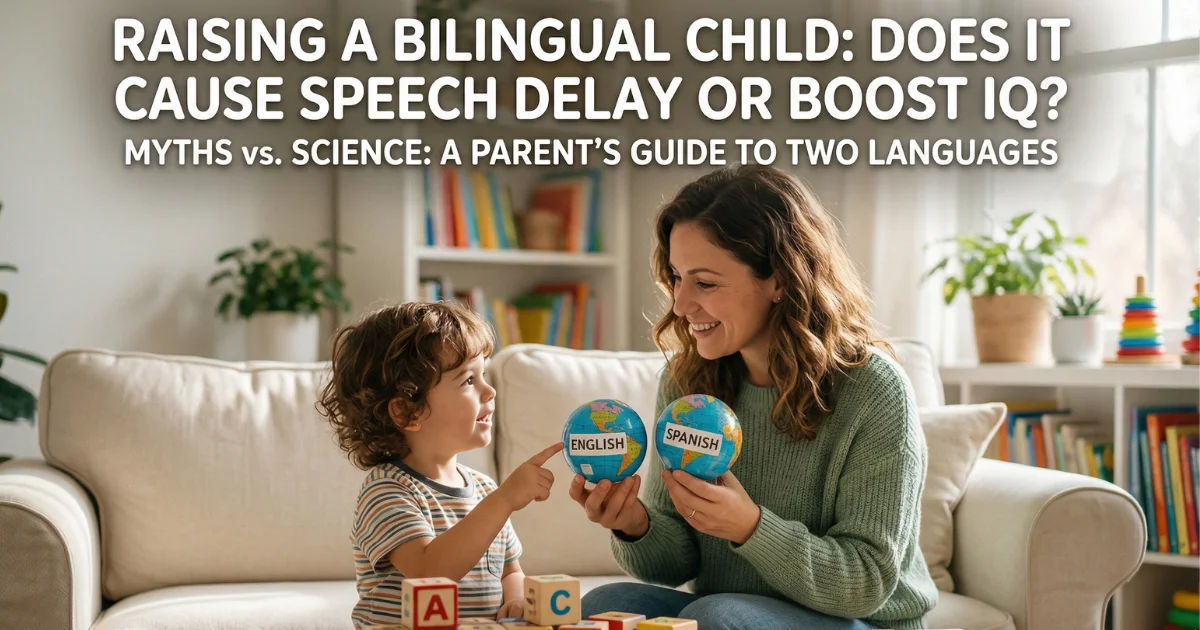
Raising a Bilingual Child: Does It Cause Speech Delay or Boost IQ?
Table of Contents
Raising a Bilingual Child: Does It Cause Speech Delay or Boost IQ?
In our increasingly interconnected world, giving a child the gift of a second language is one of the most valuable advantages a parent can provide. Whether you are a multicultural family speaking two languages at home, or monolingual parents hoping to immerse your preschooler in a new language, the benefits of bilingualism are widely celebrated.
However, alongside the excitement often comes a heavy dose of parental anxiety. The most common fear? “Will hearing two languages confuse my baby? Will it cause a speech delay?” On the flip side, some parents wonder, “Will learning two languages automatically turn my child into a baby genius with an off-the-charts IQ?”
There is a lot of conflicting information, outdated advice, and pressure surrounding bilingual parenting. Let’s separate the myths from the science and explore what actually happens inside the beautiful, developing brain of a bilingual child.
The Myth of the Bilingual Speech Delay
For decades, many well-meaning pediatricians and educators advised parents to stick to one language, warning that introducing a second language would overwhelm the child and delay their ability to speak.
Modern neuroscience and linguistics have entirely debunked this myth. Raising a child bilingual does not cause speech or language delays. A bilingual child will typically say their first words and form their first sentences within the exact same developmental windows as a monolingual child.
So, where did this persistent myth come from? It stems from a misunderstanding of how we measure a child’s vocabulary.
If you count the words a bilingual two-year-old knows in English, it might be fewer than an English-only speaking toddler. However, if you combine their English words and their Spanish (or French, or Arabic) words, their total conceptual vocabulary is almost always equal to, or even greater than, their monolingual peers. They are not delayed; their language knowledge is simply distributed across two different linguistic buckets.
Note: If a bilingual child does experience a true speech delay, it is due to an underlying language disorder (which they would have had regardless of the number of languages spoken), not the bilingualism itself. In these cases, speech therapists strongly advise parents to continue speaking their native language, as stopping does not “cure” the delay.
Code-Switching: Confusion or Brilliance?
Another reason parents fear their child is confused is a phenomenon called “code-switching” or “language mixing.” This happens when a child uses words from both languages in the same sentence (e.g., “I want more agua, please!”).
To an untrained ear, this sounds like the child cannot tell the languages apart. In reality, it is a sign of high linguistic intelligence. The child knows exactly what they want to say, and if they temporarily lack the vocabulary word in Language A, their brain rapidly retrieves the word from Language B to fill the gap and keep the communication flowing. It is a highly sophisticated cognitive workaround, not a sign of confusion.
Does Bilingualism Actually Boost IQ?
The short answer is: Bilingualism does not necessarily add raw points to a standard IQ test. However, it profoundly enhances something arguably much more important for lifelong success: Executive Function.
Executive function is the brain’s management system. It controls working memory, flexible thinking, self-control, and the ability to multitask.
Because a bilingual child’s brain houses two active language systems, it must constantly work to suppress one language while using the other. This constant, invisible mental workout acts like a gymnasium for the brain’s frontal lobe. As a result, bilingual children often demonstrate:
- Superior Focus: They are better at tuning out distractions and focusing on the task at hand.
- Cognitive Flexibility: They can switch between different tasks or rules much faster than monolingual children.
- Better Problem Solving: They are used to looking at the world through two different linguistic frameworks, which fosters out-of-the-box thinking.
Proven Strategies for Raising a Bilingual Child
Children do not learn a language just by overhearing it or watching a screen; they need consistent, interactive, and meaningful human connection. Here are the most successful strategies families use:
1. One Person, One Language (OPOL)
In this highly popular approach, each parent consistently speaks only one language to the child. For example, Mom exclusively speaks French to the baby, while Dad exclusively speaks English. This helps the child naturally compartmentalize the two languages based on the person they are interacting with.
2. Minority Language at Home (ML@H)
If both parents speak the minority language, they use it exclusively inside the house. The child then learns the majority language (like English in the US or UK) outside the home, at daycare, or at school. This provides a massive, immersive foundation in the minority language before peer pressure pushes them toward the majority language.
3. Time and Place
Families choose specific times or locations for a language. For instance, speaking Spanish only on the weekends, or speaking Mandarin exclusively during dinnertime and bedtime routines.
Frequently Asked Questions (FAQ)
Is it too late to start if my child is already 4 or 5 years old? It is never too late! While the brain is uniquely primed to absorb language effortlessly from birth to age 3, young children still have incredibly “plastic” brains. A preschooler or elementary-aged child can absolutely achieve fluency, especially through immersive play or a dual-language school program.
What if neither parent is completely fluent in a second language? You can still raise a bilingual child! You will need to rely more heavily on outside resources. Consider hiring a bilingual nanny, enrolling them in a language-immersion preschool, setting up playdates with native speakers, and introducing high-quality interactive language media.
Will my child have an accent? If a child is consistently exposed to native speakers of a language before the age of roughly 6 to 8 years old, they will almost always develop a native-sounding accent in both languages.
The Bottom Line
Raising a bilingual child requires patience, consistency, and a lot of talking. There may be moments where progress seems slow, or times when your child prefers one language over the other. Stay the course. By giving your child a second language, you are not causing a delay—you are giving them a sharper mind, a broader cultural perspective, and a lifelong tool for connection.