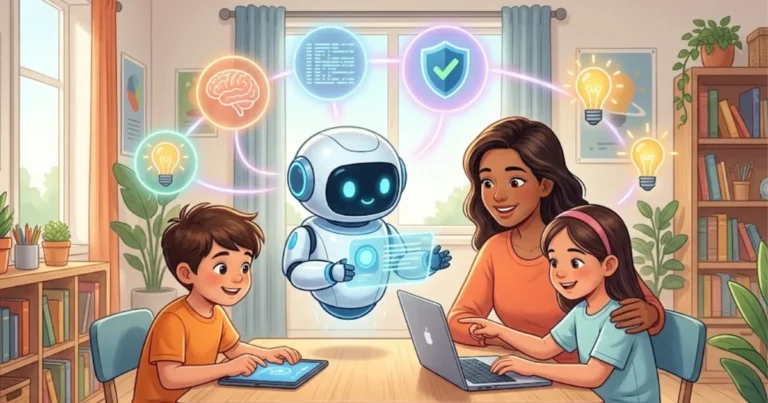

10 Beginner-Friendly Tips for Teaching AI to Kids at Home
Table of Contents
Introduction to Beginner friendly tips for Ai For kids
Artificial intelligence carries a reputation that can feel intimidating at first, especially for parents and educators who did not grow up with it and who encounter it now as a fully formed, seemingly complex force shaping the modern world. But here is something worth holding onto from the very beginning: artificial intelligence, at its core, is not nearly as mysterious as it appears from the outside. When it is introduced to children through the right lens, with the right pacing, the right language, and the right spirit of playful curiosity, it becomes not just understandable but genuinely exciting. Beginner friendly tips for AI for kids are not about dumbing anything down or skipping the substance. They are about finding the door that is already there, the one that opens naturally when you approach a big idea with patience, creativity, and a willingness to start small. Children are remarkably capable of grasping complex ideas when those ideas are presented in ways that connect to things they already know and love. The goal is never to rush toward technical mastery but to gently open a door to a world where machines learn, adapt, and assist in ways that are fascinating, sometimes surprising, and always worth exploring.
Why starting with Ai For kids can feel overwhelming at first
There is a very understandable reason why so many parents and educators feel a knot of anxiety when they first sit down to think about teaching AI to children. The terminology alone is enough to give most people pause. Machine learning, neural networks, natural language processing, algorithmic decision-making, these are phrases that sound like they belong in a graduate-level computer science seminar rather than a conversation with a seven-year-old. And beyond the vocabulary, there is the sheer scale of what AI represents, a technology that seems to be reshaping everything simultaneously, from healthcare to education to entertainment to the job market, with a speed that makes it feel almost impossible to get your bearings.
This initial overwhelm is completely natural and completely temporary. It is the feeling that comes at the beginning of any genuinely new learning experience, before the first few pieces have clicked into place and the shape of the whole has started to become visible. The most important thing to understand about this feeling is that it does not reflect the actual difficulty of the core concepts. It reflects the gap between where you are and where you need to be, and that gap closes much faster than most people expect once you commit to starting small and building from there. The parents and educators who are most effective at introducing AI to children are not necessarily those who know the most about technology. They are those who are willing to learn alongside the child, to sit with uncertainty, to ask questions openly, and to model the kind of curious, patient engagement with the unknown that they hope to cultivate in the children they are guiding.
Making AI simple and approachable for beginners
The secret to making any complex subject approachable is the same regardless of the subject: find the simplest possible version of the core idea and start there. Not a simplified version that is misleading or inaccurate, but a genuinely simple version that is true, that captures something real about the subject, and that can serve as a solid foundation for building deeper understanding over time. For artificial intelligence, that simplest true version is something like this: AI is a system that learns from examples and gets better with practice, just like people do.
This starting point is simple enough for a young child to grasp and accurate enough to serve as a genuine foundation for everything that comes after. From there, every layer of additional complexity can be added gradually, in response to the child’s growing understanding and curiosity, without ever losing the thread back to this core idea. The language used matters enormously at this stage. Familiar words, concrete examples, and comparisons to things the child already knows are far more powerful than precise technical vocabulary. Precision can come later, once the intuition is in place. Trying to build precision before intuition is like trying to build the second floor of a house before the first floor has been completed.
What Ai For kids really means in easy language
Strip away all the technical vocabulary and the hype and the headlines, and what AI for kids really comes down to is this: helping children understand how machines can learn from information and use what they have learned to make decisions and solve problems. That is the whole thing at its simplest. It is not primarily about coding, though coding can become a natural extension of this understanding later on. It is not about building robots or programming computers, though those things can be wonderful expressions of AI thinking. At its heart, AI for kids is about curiosity, observation, and the playful discovery of how intelligent systems, both artificial and human, make sense of the world around them.
When framed this way, AI stops being a subject that requires specialized knowledge to engage with and becomes something that any curious child can start exploring right now, with the materials and experiences already available to them. The child who is sorting their toys into groups is exploring classification. The child who is guessing what will happen next in a story is exploring prediction. The child who follows a set of instructions to accomplish a task is exploring algorithms. AI for kids is not a separate subject to be added to an already crowded curriculum. It is a way of looking at things children are already doing and helping them see the deeper principles at work.
Breaking down artificial intelligence into small ideas
One of the most effective pedagogical strategies for any complex subject is decomposition, breaking the large, intimidating whole into smaller, more manageable pieces that can be understood individually and then assembled back into a coherent picture. This is especially important with AI because the field is so broad and encompasses so many different ideas and applications that trying to understand it all at once is genuinely impossible. The key is identifying which small ideas are most foundational, most accessible, and most useful as starting points.
Three ideas that work particularly well as entry points for young beginners are recognition, prediction, and learning. Recognition is the idea that systems can identify patterns and categorize things, this is a cat, this is a dog, this is a happy face, this is a sad one. Prediction is the idea that systems can use what they have learned to anticipate what will happen next, based on patterns they have observed in the past. And learning is the idea that systems improve over time as they encounter more examples and get feedback on whether their predictions were right or wrong. Each of these three ideas can be explored independently through simple, concrete activities, and together they capture something genuine and important about how AI systems actually work.
How to explain AI to kids without confusion
The most confusion in early AI education comes from trying to explain things at a level of abstraction that children are not yet ready to handle. Abstract concepts need concrete anchors, and the more vivid and personally relevant those anchors are, the better they work. One of the most effective strategies is to use the child themselves as the reference point, asking them to think about how they learned something and then drawing a parallel to how an AI system learns similarly.
How did you learn to recognize different animals? At first, someone showed you a picture and told you the name. Then you saw more pictures, heard more names, and over time the associations became automatic. Now you can recognize an animal you have never seen before and make a pretty good guess about what kind of animal it is based on its features. An AI system learns in almost exactly the same way, except it learns from many more examples, much more quickly, and it never forgets what it has learned. This kind of explanation does not require any technical vocabulary and it leaves the child with a genuine, accurate understanding of the core mechanism of machine learning that will serve as a solid foundation for more sophisticated understanding later.
The best way to start Ai For kids learning
The single best way to begin AI learning with children is not with an explanation or a lesson or even an activity. It is with observation. Before any deliberate teaching happens, spend some time simply noticing AI together. Look at the recommendations that appear when you open a video streaming app and ask why those particular videos are being suggested. Listen to a voice assistant respond to a question and wonder together about what is happening inside the device to make that possible. Notice the way a navigation app adjusts its route in real time as traffic conditions change and think about what kind of learning must be going on for that to work.
This observational starting point accomplishes several things simultaneously. It grounds AI in the child’s existing experience, making it immediately relevant and personal. It establishes that AI is not something exotic and distant but something already woven into daily life. It activates the child’s natural curiosity by raising questions that do not yet have answers. And it positions both the parent and the child as curious co-investigators rather than as teacher and student, which creates a collaborative dynamic that is far more conducive to genuine learning than a more traditional instructional approach.
Starting with curiosity instead of complexity
There is a principle worth stating clearly and returning to often: in AI education for children, curiosity is more valuable than knowledge. A child who is genuinely curious about how something works will find their own way to understanding it, given time and support and access to good resources. A child who has been given a lot of information about AI but has not had their curiosity engaged has very little of lasting value, because the information will fade without the curiosity to keep driving engagement with the subject.
Everything about how AI learning is introduced to young children should be designed to activate and sustain curiosity rather than to transfer information. This means asking more questions than you answer. It means celebrating what the child does not yet know as much as what they do. It means following the child’s interests into AI rather than directing their interests toward AI. It means being genuinely excited about the questions that do not yet have answers, because the field of AI is full of them, and that openness to mystery is one of the things that makes it such a rich and exciting subject to explore.
Using simple real life examples to introduce AI
Real-life examples are the most powerful tool available for making AI concrete and comprehensible for young learners. The most effective examples are ones that the child encounters in their own daily life, that they interact with regularly, and that they already find useful or interesting in some way. Voice assistants that answer spoken questions, video platforms that recommend content, music apps that seem to know what you are in the mood for, navigation apps that find the fastest route, email filters that separate important messages from spam, these are all AI systems that most children already interact with regularly and that can become immediate, tangible illustrations of AI principles in action.
The key to using these examples effectively is to go beyond simply pointing to them and instead engaging the child in thinking about how they work. What does the voice assistant need to know in order to answer a spoken question correctly? How does the video platform decide which videos to recommend? What information does the navigation app use to figure out the fastest route? These questions do not require technical answers. They require thinking, and the thinking itself builds understanding that is far more durable than any explanation could produce.
Turning everyday tech into learning moments
One of the most practical and sustainable approaches to AI education for children is to turn the technology that is already part of family life into a continuous source of learning moments rather than treating AI education as a separate activity that happens at designated times. This approach requires no special materials, no scheduled lessons, and no particular technical expertise. It simply requires the habit of noticing and wondering together about the AI that is already present in everyday digital interactions.
When a streaming platform suggests a new show, you can ask your child what they think the app knows about them that made it choose that particular suggestion. When autocorrect changes a word on a phone, you can wonder together about how the phone knew what word was intended. When a map app warns about traffic ahead, you can think about where that information came from and how the app processed it to generate a useful warning. Each of these small moments of noticing and wondering is a genuine learning experience, and their cumulative effect over weeks and months is a rich, deeply grounded understanding of AI that no amount of formal instruction could match.
Beginner friendly ways to explain AI concepts
The most powerful explanatory tools for AI concepts with young beginners are the same tools that have always worked best for making complex ideas accessible: stories, games, and direct demonstration. Each of these approaches engages different cognitive and emotional systems, creating multiple pathways to understanding that reinforce each other and make the ideas both more accessible and more memorable than any single explanation could achieve on its own.
Stories work because they embed abstract ideas in human contexts that children can emotionally relate to. Games work because they create direct, experiential learning where the child discovers the principle for themselves rather than being told it. Demonstrations work because they make abstract processes visible and concrete, allowing children to see rather than just hear about how things work. Used in combination, these three approaches can make virtually any AI concept accessible to a child who is developmentally ready for it, regardless of how technically complex the underlying mathematics or computer science might be.
Explaining machine learning with fun analogies
Analogies are among the most powerful tools in the entire toolkit of effective explanation, because they allow an unfamiliar concept to borrow the clarity and familiarity of something the learner already understands. The best analogies for machine learning with children are those that are vivid, personally relevant, and structurally accurate enough to build genuine understanding rather than misleading oversimplification.
One particularly effective analogy is the idea of teaching a pet new tricks. When you teach a dog to sit, you show the dog what sitting means, you reward it when it gets it right, and you repeat the process many times until the behavior becomes automatic. The dog has learned from examples, guided by feedback, through repetition. Machine learning works in a remarkably similar way, except the examples are data, the reward is a mathematical signal that measures how accurate the prediction was, and the repetition happens millions of times rather than dozens. The analogy is not perfect, but it is accurate enough to build a genuine, useful understanding of the core mechanism, and it is memorable in a way that a technical explanation never could be.
Using games to show how AI learns patterns
Pattern recognition is so central to how AI systems work that giving children direct experience of finding and working with patterns is one of the most foundational things you can do in early AI education. The good news is that children love pattern games and are naturally quite good at them, because pattern recognition is also a fundamental human cognitive capacity that develops early and eagerly in most children.
Simple pattern games can start with physical objects, alternating sequences of colored blocks, repeating arrangements of shapes, rhythmic sequences of sounds, and ask children to identify the pattern and predict what comes next. As children become more comfortable, the patterns can become more complex, involving multiple variables simultaneously, introducing exceptions and edge cases, or asking children not just to continue a pattern but to articulate the rule that governs it. This progression from simple to complex, from concrete to abstract, mirrors exactly the progression that any good AI curriculum for children should follow, and it builds the kind of deep, flexible pattern-recognition thinking that will serve children well across many domains.
Teaching decision making through simple choices
Decision making is another concept that is central to AI and also deeply familiar to children from their own experience. Every day, children make dozens of decisions, what to eat, what to play with, which book to choose, whether to take one path or another. By drawing attention to how these decisions are made, what information is considered, what criteria are used to evaluate options, and what outcome is chosen as the result, you can help children develop an explicit understanding of decision processes that directly illuminates how AI decision systems work.
Simple binary choice games, is this fruit or vegetable, is this animal or machine, is this indoor or outdoor, introduce the concept of classification in its most basic form. Scenario-based choices, if it is raining, what should you wear, build the concept of conditional decision making. And asking children to explain their reasoning after making a choice, what made you choose that rather than this, develops the metacognitive awareness of decision processes that is one of the most sophisticated outcomes of early AI education.
Fun and easy activities for Ai For kids beginners
The best activities for beginner AI learners share a set of common characteristics that are worth keeping in mind when choosing or designing them. They are hands-on rather than passive. They are short enough to complete before attention begins to flag. They produce a visible, concrete result that the child can see and feel proud of. They are flexible enough to allow for different approaches and different levels of engagement. And they naturally raise interesting questions that invite further exploration rather than closing down curiosity once the activity is complete.
Activities that meet these criteria exist across a wide range of formats, from physical sorting games to digital drawing experiments to role play scenarios to storytelling challenges, and the variety itself is an important feature. Rotating through different kinds of activities keeps learning fresh, engages different cognitive and creative capacities, and helps children encounter AI concepts from multiple angles, building a more comprehensive and flexible understanding than any single activity type could produce.
Sorting games to teach classification
Classification is so fundamental to AI that it deserves particular attention as a starting activity for young beginners. The concept is simple: sorting things into groups based on their shared characteristics. But the thinking underneath it is rich and interesting, raising questions about what features matter for a particular classification task, what to do with objects that seem to fit in more than one category, and how to handle cases that do not fit neatly into any of the established categories.
Start with a mixed collection of everyday objects, toys, kitchen items, colored blocks, pieces of paper cut into different shapes, and ask your child to sort them in whatever way makes sense to them. Then ask them to explain their sorting rule. Then challenge them to sort the same objects by a different rule. Notice together how the same set of objects can be organized in many different ways depending on what you are trying to achieve. This flexibility in classification, the understanding that categorization is a choice driven by purpose rather than an objective fact about the objects, is a subtle but important insight that will serve children well as they develop more sophisticated understanding of how AI classification systems are designed and what their limitations are.
Prediction games to explain how AI guesses
Prediction might be the AI concept that children find most immediately intuitive, because humans are natural predictors who are constantly generating expectations about what will happen next based on past experience. Tapping into this existing capacity and making it explicit is a wonderfully effective way to introduce the concept of predictive AI systems.
Begin with simple, concrete predictions. Before opening a bag of mixed snacks, predict what color the first one will be. Before flipping a card, predict whether it will be higher or lower than the last one. Before finishing a familiar story, predict what the character will do next. After making each prediction, talk about why you made it. What information did you use? How confident were you? Were you right? If not, why not? What would you predict differently next time? This cycle of prediction, observation, reflection, and revision is not just good AI thinking. It is good scientific thinking, and it builds the kind of evidence-based, self-correcting reasoning that serves children across every domain of their intellectual lives.
Simple drawing games to explore AI creativity
Art and drawing activities offer a wonderful entry point for exploring how AI systems interpret and generate visual information. Even very young children can engage with the fundamental question that underlies computer vision, how do you describe a visual image in a way that a system without eyes could understand and learn from?
Ask your child to draw an object without telling you what it is and then see whether you can guess. Talk about which features of the drawing gave it away and which were ambiguous or misleading. Then try the reverse, give your child a verbal description of something and ask them to draw it, and compare what they drew with what you were imagining. These exercises in translating between visual and verbal representations are directly relevant to how AI systems process visual information and how text-to-image AI systems work, and they develop the kind of precise observational and descriptive thinking that is valuable far beyond AI education specifically.
Storytelling as a beginner friendly AI teaching method
Stories have been the primary vehicle for transmitting knowledge, values, and understanding across human cultures for as long as humans have had language. There is a reason for this that goes beyond tradition. Stories engage not just the intellect but the emotions, the imagination, and the memory in ways that purely propositional explanations do not. When an idea is embedded in a story, it acquires context, meaning, and emotional resonance that makes it far more memorable and far more personally significant than the same idea presented as a fact or a definition.
For AI education specifically, storytelling is powerful because it allows complex ideas about how intelligent systems perceive, learn, decide, and act to be explored in human terms that children can immediately relate to. A story about an AI character who is trying to learn to recognize different flowers, who makes mistakes at first and gets frustrated but keeps practicing, and who eventually becomes very good at identifying flowers and helps a gardener take care of their plants, can communicate more genuine understanding of machine learning than many hours of more formal instruction.
Creating stories where AI is a helpful character
The character of the AI in a story for children does not need to be technologically realistic to be educationally valuable. What matters is that the AI character is portrayed in a way that illuminates genuine principles of how AI systems work, even if the context is fantastical or simplified. An AI character who needs to be shown many examples before they can learn something, who makes predictable mistakes when they encounter situations outside their training, and who improves steadily with practice and feedback, is communicating something genuinely accurate about machine learning, even if everything else about the story is pure imagination.
Inviting children to create these characters themselves, to think about what their AI character knows and does not know, what they are good at and what they struggle with, what happens when they encounter an unexpected situation, develops a much richer and more accurate intuitive model of AI than any amount of passive explanation. The act of creation requires the child to think through the implications of the concepts in a way that listening or reading never demands.
Letting kids guide the story like an AI system
One particularly elegant storytelling activity is to put the child in the position of the AI system, asking them to respond to story inputs the way an AI would. You describe a situation, and the child must decide what the AI character does based only on the rules and information they have established for that character. What happens when the AI encounters something outside its known categories? What does it do when two rules seem to conflict? How does it handle incomplete or ambiguous information?
These are not just engaging story problems. They are the genuine challenges that AI system designers grapple with in real technical work, and children who think through them in the context of storytelling develop genuinely useful intuitions about the design and limitations of AI systems. The playful context makes the thinking feel natural and enjoyable rather than effortful and technical, which is exactly the emotional environment in which the deepest learning happens.
Building imagination while learning AI basics
Imagination and analytical understanding are often treated as opposites, as if the more precisely and technically you understand something, the less room there is for imaginative engagement with it. The reality is quite the opposite. Genuine understanding opens up imagination rather than constraining it, because you can only imagine new possibilities within a domain when you understand the principles well enough to know which possibilities are genuinely interesting and which are simply impossible. Encouraging children to imagine AI systems, to invent their own AI characters, to design imaginary intelligent machines, is not a distraction from learning the basics. It is one of the most powerful ways to deepen and consolidate them.
Using play to make Ai For kids enjoyable
Play is not the sugar coating on the medicine of learning. It is the medium in which the most natural and lasting learning happens for children. When children play, they are in a state of heightened engagement, voluntary focus, and intrinsic motivation that creates ideal conditions for genuine learning. The absence of external pressure in play means that children can take risks, make mistakes, try unconventional approaches, and follow interesting tangents without any of the anxiety about performance that can inhibit learning in more formal contexts.
Designing AI learning as play rather than as instruction means thinking primarily about engagement, about what will make the child want to keep going, want to try the next thing, want to come back tomorrow and do it again. When AI activities consistently produce this quality of engagement, the learning that results is deep, durable, and self-sustaining, because the child has developed not just knowledge of AI concepts but a genuine enjoyment of the process of thinking about them.
Role play games where kids act as AI
Role play is a uniquely powerful learning modality because it asks the learner to do something qualitatively different from simply understanding an idea. It asks them to inhabit it, to experience from the inside what it would be like to be the thing they are learning about. When children play the role of an AI system, responding to inputs, following rules, making decisions based on available information, and handling unexpected situations, they develop an empathic understanding of AI that is qualitatively different from and in many ways deeper than any amount of observational or analytical learning.
The most effective AI role play activities build in the key features of real AI systems: the dependence on rules and examples, the difficulty of handling novelty, the way performance improves with practice and feedback, and the genuine limitations that even sophisticated AI systems face when they encounter situations outside their training. A child who has experienced these features from the inside in a role play context has developed genuine insight into what AI can and cannot do that will serve them well as they encounter AI systems in more sophisticated contexts throughout their lives.
Learning through fun challenges and puzzles
Puzzles occupy a special place in the landscape of educational activities because they create a very particular kind of engagement that is both inherently motivating and cognitively rich. A good puzzle presents a challenge that is difficult enough to require genuine effort and thinking but achievable enough to allow success with persistence and the right approach. This balance between difficulty and achievability creates a state of focused engagement that psychologists call flow, a state that is both highly enjoyable and highly productive for learning.
For AI education specifically, puzzles that require logical reasoning, pattern recognition, sequential thinking, and creative problem solving are particularly valuable because they develop the exact cognitive capacities that underlie AI thinking. Puzzles that have multiple valid solutions, or that can be solved by different approaches leading to the same outcome, are especially good for building the flexible, divergent thinking that is one of the most valuable outcomes of AI education.
Turning learning into a playful experience
The practical question of how to turn learning into a playful experience is really a question of design. What features need to be present for an activity to feel like play rather than like work? Several things matter enormously. The activity needs to feel voluntary, like something the child is choosing to do because they genuinely want to, not because they are being required to. It needs to offer real choices that actually affect outcomes, creating a sense of genuine agency. It needs to provide immediate, visible feedback on what is happening, making the consequences of decisions clear and satisfying. And it needs to be open-ended enough that there is always more to explore, always another interesting question to pursue, always another level of depth available to a child who wants to go deeper.
When AI activities are designed with these features in mind, children do not experience them as learning activities at all. They experience them as genuinely engaging things they want to do, and the learning happens as a natural byproduct of engagement rather than as a separate goal being pursued through the activity.
Best beginner tools for Ai For kids
The landscape of AI learning tools for children has expanded dramatically in recent years, and choosing among the many available options can itself feel overwhelming for beginners. A few principles can help simplify the selection process considerably. The most important is that the tool should match the child’s current developmental stage and level of understanding, not in a condescending way, but in the genuine sense that the challenges it presents are at the right level of difficulty to be engaging without being frustrating. Too easy and the child is bored. Too hard and the child is discouraged. The sweet spot is the zone of proximal development, the range of challenges that are just beyond current capability but achievable with effort and support.
Easy apps designed for young learners
The best beginner apps for AI education are those that use visual, intuitive interfaces that allow children to engage with AI concepts without needing to master complex syntax or abstract programming logic. Drag-and-drop interfaces, visual programming environments, and game-based learning platforms that embed AI concepts in playful challenges are all excellent starting points. The key characteristic to look for is whether the app invites genuine thinking and experimentation or whether it simply requires children to follow instructions and execute procedures. Apps that reward curiosity, that respond interestingly to unexpected inputs, and that give children genuine agency over outcomes are far more educationally valuable than those that simply guide children through a predetermined sequence of steps.
Safe platforms for exploring AI basics
Safety is not an afterthought in choosing digital tools for children. It is a primary consideration that should be evaluated carefully before any tool is introduced. A safe platform for children’s AI learning is one that has clear, strict data privacy policies that do not collect or misuse children’s personal information. It is moderated to prevent exposure to inappropriate content. It does not require personal details to use effectively. It is transparent about how it works and what it does with any data it gathers. And it creates an environment where children can explore and experiment without encountering content or interactions that are not age appropriate.
Visual tools that require no coding skills
One of the most significant developments in AI education for young learners in recent years has been the proliferation of visual tools that make it possible to explore genuine AI concepts without any coding ability. These tools use visual metaphors, drag-and-drop interfaces, and interactive demonstrations to make the logic of AI systems visible and manipulable without requiring the child to write a single line of code. This democratization of access to AI concepts is enormously important because it means that AI understanding is no longer confined to children who are already interested in programming and comfortable with abstract syntax. It becomes accessible to every child with a curious mind and a willingness to explore.
How to choose beginner friendly AI tools
Beyond safety and visual accessibility, the most important criterion for choosing AI tools for young beginners is whether the tool builds genuine understanding or merely creates an impression of learning. Some tools are very engaging and very polished in their presentation but ultimately teach children to perform specific procedures without developing any real insight into the underlying principles. Other tools are less visually impressive but create genuinely rich learning experiences where children develop authentic understanding that transfers to new contexts. The distinction can sometimes be hard to identify from the outside, but a useful test is to ask whether, after using the tool, the child can explain in their own words what they learned and apply the insight to a new situation they have not encountered before.
Looking for simplicity and safety features
Simplicity in an AI learning tool does not mean lack of depth. It means that the interface, the instructions, and the core concepts are presented in a way that is immediately accessible to a beginner without requiring extensive prior knowledge or technical background. The simplest tools are often the ones that have been most thoughtfully designed, because achieving genuine simplicity without sacrificing substance is one of the hardest design challenges there is. Look for tools where the first interaction feels immediately understandable and rewarding, where the path from beginner to more advanced use is gradual and well-supported, and where the design clearly reflects a deep understanding of how children learn.
Picking tools based on age and interest
A tool that is perfect for a ten-year-old who loves mathematics and logical puzzles will be completely wrong for a six-year-old who loves stories and drawing, even if both children are at the same level of AI knowledge. Age and developmental stage matter because they determine what cognitive operations the child is capable of performing and what kinds of contexts and challenges feel natural and engaging. Interest matters because engagement is the engine of learning, and a child who is pursuing an idea they genuinely care about will go much further and learn much more than a child who is going through the motions with content that does not resonate with them personally.
Avoiding complex or overwhelming platforms
The damage done by introducing a child to a platform that is too complex for them at their current level of understanding can extend well beyond the immediate frustration of the experience. When children’s first encounters with AI learning tools are confusing and discouraging, those negative associations can persist and create lasting barriers to engagement that take significant time and effort to overcome. It is far better to start with a tool that feels almost too simple and to move up to more complexity as the child demonstrates readiness than to push toward complexity prematurely and risk creating a lasting negative relationship with the subject.
Helping kids understand how AI works
Understanding how AI works at a level that is genuinely useful for a young learner does not require mastery of mathematics or computer science. It requires a clear intuitive model of the core processes, the kind of model that allows a child to make reasonable predictions about how an AI system will behave in a new situation, to recognize when an AI is making an error and have some sense of why, and to think intelligently about what an AI system would need to learn in order to accomplish a new task. Building this intuitive model is the primary goal of AI education for beginners, and it is best accomplished not through explanation but through direct experience.
Explaining how AI learns from examples
The concept of learning from examples is so central to modern AI that it deserves to be explored from multiple angles and through multiple activities until it becomes truly intuitive for the child. The core idea is simple: the system gets better at a task by seeing many examples of the task being performed correctly, along with feedback on how it performed. Each example teaches it something small, and those small lessons accumulate into genuine capability over time.
To make this concrete for a child, you can set up a simple teaching game where you are the AI and the child is the teacher. The child shows you examples of two categories, say, drawings of cats and drawings of dogs, and tells you which is which. Then they show you a new drawing and ask you to classify it. After several rounds, discuss together what features you were using to tell the two categories apart and what would happen if someone showed you a drawing that had features of both. This game puts the child in the position of the designer and the teacher, giving them genuine insight into both the power and the limitations of learning from examples.
Showing how repetition improves results
Repetition is not just a boring feature of learning that we endure in order to memorize things. It is a fundamental mechanism of both human and machine learning, the way that initially effortful processing becomes automatic and reliable over time. Helping children understand the role of repetition in AI learning is important because it explains why AI systems need to be trained on so many examples, and why the quality and variety of those examples matters so much.
A simple demonstration that makes this vivid is to try teaching a child a new skill, say, identifying a particular bird species, with just one example versus many examples. After seeing one picture of a specific bird, the child might struggle to identify it reliably in photographs taken from different angles or in different lighting. After seeing twenty different photographs, they become much more reliable. After seeing a hundred, they can probably identify the bird even in challenging conditions. This personal experience of how repetition builds robust recognition directly illuminates the training process of AI systems.
Using simple step by step demonstrations
Step-by-step demonstrations are particularly valuable for AI education because many of the most important AI concepts involve processes that happen in a specific sequence, where understanding the order of the steps and the role of each step is essential to understanding the whole. Showing rather than just telling these sequences makes them far more accessible and memorable, because the child can see the process unfolding in real time and develop an intuitive sense of how each step connects to the next.
For young beginners, the most effective demonstrations are those that use physical objects and visible actions rather than abstract symbols on a screen. Walking through the steps of a classification task using actual objects that can be moved and sorted, or demonstrating an algorithm using physical movements of the body, makes the abstract sequence concrete and embodied in a way that purely digital demonstrations cannot match.
Building confidence with small AI lessons
Confidence is not a prerequisite for learning. It is a product of it, built through the accumulation of experiences where genuine effort led to real understanding and success. This means that the structure of early AI learning experiences matters enormously for the confidence children develop about their ability to understand AI. Early lessons should be designed to ensure success, not by being trivially easy, but by being calibrated so that the effort required leads reliably to the rewarding experience of understanding something new.
Short, focused lessons that accomplish one clear thing are far better for confidence building than long, ambitious sessions that cover a lot of ground without achieving deep understanding of any of it. When a child finishes a short AI lesson with the genuine sense that they now understand something they did not understand before, and that this new understanding is real and usable and theirs, they leave with a small but significant increase in confidence that accumulates over time into the kind of robust self-belief that sustains learning through much greater challenges.
Starting with short and easy activities
The optimal length of an AI learning session for a young beginner is probably shorter than most parents and educators intuitively expect. For children under eight, fifteen to twenty minutes of focused, engaging activity is often the maximum before attention and enthusiasm begin to flag. For older children, thirty to forty-five minutes is a reasonable target. These may seem like short windows for learning, but they are actually quite sufficient when the activity is well-designed and the focus is on depth rather than breadth. One genuinely understood concept developed thoroughly in twenty minutes is worth far more than three concepts skimmed superficially in an hour.
Celebrating small learning wins
In the long journey of learning any complex subject, the small wins along the way are not just pleasant moments to acknowledge and move past. They are the fuel that keeps the journey going. When children feel that their progress is noticed, valued, and celebrated, not with hollow praise that they quickly learn to discount, but with genuine enthusiasm for the specific thing they have accomplished, they develop the intrinsic motivation that is the most reliable engine of sustained learning.
Make it a habit to name specifically what the child has accomplished at the end of each AI activity. Not just great job but something like today you figured out how to sort things by more than one rule at the same time, and that is exactly how AI classification systems work. This specific recognition connects the child’s accomplishment to the broader context of what they are learning and gives them a growing sense of genuine capability that motivates continued engagement.
Encouraging kids to try without fear
Fear of getting things wrong is one of the most significant and most underappreciated obstacles to learning in children. It manifests not as obvious reluctance but as a subtle narrowing of engagement, a tendency to stick to what is already known rather than reaching toward what is not yet understood, a preference for correct performance over genuine exploration. Creating conditions where children feel genuinely safe to try things that might not work is therefore one of the most important things adults can do to support AI learning.
The most effective way to create this safety is not through reassuring words but through consistent experience. When a child tries something that does not work and the adult’s response is curious and constructive rather than disappointed or corrective, the child learns through experience that trying and failing is acceptable. When the adult also tries things that do not work and responds to their own failures with equanimity and curiosity, the child learns that getting things wrong is a normal part of learning for everyone, not a sign of personal inadequacy.
Creating a positive learning environment
The emotional climate of a learning environment has a profound effect on the quality of learning that happens within it. Children learn best in environments that feel safe, warm, stimulating, and supportive, where there is genuine enthusiasm for ideas, where questions are celebrated rather than merely tolerated, where mistakes are treated as interesting rather than unfortunate, and where the people around them are genuinely enjoying the process of exploration and discovery.
Creating this environment requires consistent attention to the emotional texture of learning experiences, not just their intellectual content. It means bringing genuine enthusiasm rather than performed enthusiasm. It means being honest about uncertainty rather than projecting false confidence. It means showing real curiosity about the child’s thinking rather than simply evaluating whether it is correct. And it means caring more about the quality of the child’s engagement with ideas than about any particular learning outcome.
Keeping lessons relaxed and pressure free
Pressure is the enemy of genuine learning. This is not just an intuitive feeling but a well-established finding from cognitive science. When children are anxious about performance, about being evaluated, about getting things right, cognitive resources that would otherwise be available for learning are diverted to managing the anxiety, and the quality and depth of learning suffers accordingly. Keeping AI learning experiences relaxed and pressure-free is not just a matter of making them more pleasant, though it certainly does that. It is a matter of creating the conditions that allow the brain to learn most effectively.
In practice, this means never turning AI activities into tests or evaluations. It means responding to incorrect answers with curiosity and exploration rather than correction. It means explicitly separating AI learning activities from any kind of grading or formal assessment. And it means consistently signaling through your words, your tone, and your behavior that the point of the activity is exploration and discovery, not performance and evaluation.
Allowing mistakes as part of learning
One of the most important conceptual shifts that both children and adults need to make in order to learn AI effectively is the shift from seeing mistakes as failures to seeing them as information. In AI systems, errors are not just tolerated. They are essential to the learning process. Every time an AI system makes a wrong prediction, it generates information about what it got wrong and why, and that information is used to adjust the system’s parameters so that it is less likely to make the same mistake next time. The error is not a problem. It is the feedback that drives improvement.
Helping children internalize this understanding, not just as an abstract idea but as a lived experience of their own learning process, is one of the most valuable things that AI education can accomplish. A child who genuinely believes that their own mistakes are valuable information rather than evidence of inadequacy approaches learning with a fundamentally different and far more productive orientation than one who has learned to experience mistakes as something to be avoided at all costs.
Encouraging exploration and creativity
The frontier of AI is not a tidy, well-mapped territory with clear paths and known destinations. It is an open, rapidly evolving landscape full of unsolved problems, unexpected discoveries, and possibilities that have not yet been imagined. The children who will make the most important contributions to this frontier are not necessarily those who master existing techniques most efficiently. They are those who bring creative, original thinking to problems that existing approaches have not yet solved.
Nurturing this creative orientation from the beginning of AI education means consistently leaving room for open-ended exploration, for children to follow their own curiosity, to try unconventional approaches, to combine ideas in unexpected ways, and to ask questions that do not yet have answers. The structure of AI learning should include plenty of open space, activities with no predetermined correct outcome, challenges that admit multiple valid solutions, and invitations to imagine and invent rather than simply to learn and apply.
Balancing screen time while learning AI
The question of screen time in the context of AI education is a nuanced one that deserves a more thoughtful answer than simply more or less. The most important insight is that screen time is not a single, homogeneous activity that can be evaluated solely by its duration. An hour of rich, interactive, genuinely educational engagement with AI concepts through a well-designed digital tool is categorically different from an hour of passive consumption of algorithmically curated entertainment content, even though both register as an hour of screen time by any simple measure.
What matters is not the raw quantity of screen time but its quality, its intentionality, and its balance with the full range of activities that children need for healthy development. AI learning through screens should be active rather than passive, interactive rather than consumptive, and deliberately balanced with physical activity, face-to-face social engagement, creative play away from screens, and time in the natural world.
Setting limits for healthy tech use
Clear, consistent limits on technology use serve children not as restrictions on their freedom but as the framework within which genuine freedom is possible. When children know that screen time has a defined beginning and end, they can engage with it fully and then move on to other activities without the low-grade anxiety that comes from open-ended access. The specific limits that work best vary by age, family routine, and individual child, but the key principle is that limits should be established thoughtfully, explained clearly, and enforced consistently rather than applied arbitrarily or changed unpredictably.
Mixing offline activities with AI learning
The richest AI learning happens not within screen-based activities alone but in the integration of digital and physical learning experiences that illuminate and enrich each other. The concepts encountered in a digital AI activity become more real and more deeply understood when they are followed up with physical experiments that test the same principles in the tangible world. The physical sorting game enriches the digital classification activity. The outdoor pattern-spotting walk deepens the understanding of the pattern recognition algorithm explored on the screen. Designing AI learning as an integrated experience that moves fluidly between digital and physical contexts is both more educationally effective and more developmentally appropriate than keeping digital learning siloed from the rest of the child’s experience.
Keeping a balanced daily routine
Consistency is one of the most underrated virtues in children’s learning. Not the consistency of doing exactly the same thing every day, which would quickly become boring and counterproductive, but the consistency of a reliable rhythm that includes time for AI learning as a natural, expected part of the day rather than something that happens occasionally and unpredictably. When AI learning has a consistent place in the daily routine, it accumulates momentum in a way that sporadic sessions never can. Each session builds on the last, vocabulary and concepts become familiar through regular revisiting, and the child develops a sense of ongoing progress and growing capability that sustains engagement over the long term.
Teaching responsible AI usage from the start
The habits of responsible, thoughtful technology use are best established early, before careless or harmful patterns have had a chance to form. Children who grow up understanding that technology is a powerful tool that can be used well or poorly, that it has real effects on real people and on the world, and that using it responsibly is both a personal value and a civic responsibility, are far better prepared for the digital world they will inhabit as adults than children who have simply been taught to use tools effectively without any consideration of the broader implications.
In the context of AI learning specifically, responsibility means understanding that AI systems can be biased, that they can make mistakes with real consequences, that the data used to train them matters enormously, and that the decisions about how to design and deploy them are ethical decisions as much as technical ones. Introducing these ideas in age-appropriate ways from the very beginning of AI education plants seeds of critical awareness that will grow into the kind of thoughtful, responsible engagement with AI that the world genuinely needs.
Explaining digital safety in simple terms
Digital safety for young children does not need to be explained in technical terms or through frightening scenarios. It can be introduced simply and positively as a set of habits and values that protect children and others in the digital world. Just as we teach children to look both ways before crossing the street not to frighten them but to empower them with the knowledge they need to be safe, we can teach digital safety as practical wisdom that enables confident, positive engagement with digital tools rather than anxiety about them.
The most important digital safety concepts for young AI learners include understanding the difference between public and private information, recognizing that not everything presented by digital systems is accurate or reliable, understanding that interactions in digital environments have real effects on real people, and developing the habit of pausing to think before sharing or engaging online.
Encouraging respectful use of technology
Respect in digital environments is not a soft skill or an optional add-on to technical competence. It is a foundational value that shapes everything about how a person engages with digital tools and with the other people they encounter through them. Children who learn from the beginning that digital interactions are real interactions, that the people on the other side of the screen are real people with real feelings, and that the systems they interact with have been built by real people with real values and real limitations, develop a relationship with technology that is both more ethical and more sophisticated than one based purely on instrumental efficiency.
Helping kids understand basic privacy
Privacy is a concept that children can understand in age-appropriate terms from quite a young age. The core idea, that some information about ourselves is personal and should not be shared publicly without our consent, is one that children already understand from their offline lives. Translating this understanding to digital contexts, helping children recognize what kinds of information are personal, understanding why digital systems often want to collect information about users, and developing the judgment to decide what to share and what to keep private, is an important part of digital literacy that is most effectively established early.
Common beginner mistakes to avoid
Being aware of the most common mistakes made by beginners in AI education, whether parents, educators, or children themselves, allows them to be anticipated and avoided rather than stumbled into after the damage has been done. These mistakes are not signs of failure or inadequacy. They are the natural consequences of enthusiasm meeting a complex new domain without the benefit of prior experience, and awareness of them is all that is usually needed to avoid them.
Overloading kids with too much information
The most damaging mistake in early AI education is also the most common one: trying to cover too much too quickly. When parents or educators are excited about a subject and eager for children to benefit from it, the natural impulse is to share everything at once, to give the child access to the full richness of the field as quickly as possible. But this impulse, however well-intentioned, is counterproductive. The human brain, especially the developing brain of a child, can only absorb and integrate a limited amount of genuinely new information at once. Exceeding this limit does not just fail to produce learning. It actively interferes with it by creating confusion and cognitive overload that makes even the simple things harder to understand.
Moving too fast without building basics
Every advanced concept in AI rests on a foundation of more basic concepts, and trying to build upward before the foundation is solid produces an unstable structure that will eventually collapse under its own weight. The pressure to move quickly, driven by enthusiasm, by comparison to other children, or by the sheer richness and excitement of what is further along the learning path, is one of the most common causes of frustration and discouragement in children’s AI education. Resisting this pressure, staying with foundational concepts until they are genuinely consolidated, and trusting that solid foundations will support faster progress later, is one of the most important disciplines in effective early AI education.
Focusing on tools instead of understanding
There is a seductive version of AI education that focuses primarily on teaching children to use specific tools, to navigate particular platforms, to execute particular procedures, without developing any genuine understanding of the concepts those tools embody. This approach can produce impressive-looking results in the short term, children who can operate AI tools with apparent competence, but it produces very little of lasting value because it builds no transferable understanding. When the specific tool changes, as all tools eventually do, the child has nothing to fall back on. Genuine conceptual understanding, by contrast, transfers readily to new tools and new contexts, because it is not about any particular implementation but about the underlying principles that all implementations share.
How parents can support beginner learners
The role of the parent in a child’s AI learning journey is neither the expert who delivers knowledge nor the supervisor who monitors performance. It is the curious companion who explores alongside, the enthusiast who brings genuine excitement to the shared discovery of interesting ideas, the patient supporter who is there when things get frustrating and who consistently models the belief that persistence pays off. This role does not require technical knowledge about AI. It requires genuine interest, genuine patience, and a genuine willingness to not know things and to find out.
Learning together with your child
Learning alongside your child rather than ahead of them is one of the most powerful things you can do for their development as an AI learner, and it is also one of the most rewarding things you can do for yourself. When you approach AI concepts with genuine curiosity rather than the authority of prior knowledge, several important things happen. Your child sees that learning is a lifelong activity, not something that ends when you grow up. They see that adults can be beginners too, and that being a beginner is not shameful but exciting. And they benefit from your adult capacity to make connections, ask questions, and sustain engagement with complex ideas, even while you are encountering the specific AI concepts for the first time alongside them.
Asking questions and exploring answers
The quality of questions an adult asks alongside a child during AI learning activities is one of the strongest predictors of how deep and durable the child’s learning will be. Questions that invite genuine thinking, that open up rather than close down, that treat uncertainty as interesting rather than problematic, create the conditions for real intellectual engagement. The best questions are often ones to which the adult does not already know the answer, because the child can sense the difference between a question asked for their benefit and a question asked out of genuine curiosity, and they respond to genuine curiosity with genuine thinking.
Being patient and supportive
Patience in the context of children’s learning is not passive waiting for the child to catch up. It is active, engaged, supportive presence that trusts the child’s developmental process and resists the urge to rush, redirect, or rescue prematurely. Patient support looks like sitting with a child who is struggling with a concept without immediately offering the answer. It looks like asking one more question rather than providing the explanation. It looks like staying present and engaged even when the pace of learning feels frustratingly slow, because the child’s experience of unconditional support in the face of difficulty is one of the most powerful things you can give them.
Keeping Ai For kids engaging over time
Sustained engagement with any subject over the months and years required to develop genuine understanding is one of the greatest challenges in education. Novelty is easy to create at the beginning, when everything is new and interesting. The challenge is maintaining genuine engagement as the initial novelty wears off and the real work of building deep understanding begins. In AI education specifically, several strategies are particularly effective for maintaining engagement over time.
Rotating activities to keep things fresh
Variety is one of the most reliable tools for maintaining long-term engagement. When the same concepts are explored through different types of activities, different formats, different contexts, and different challenges, each encounter with the concept brings something new while also reinforcing what has already been learned. The child who has explored classification through physical sorting games, digital apps, storytelling, drawing, and real-world observation has a richer, more flexible understanding of the concept than one who has encountered it through only one type of activity, and they are also less likely to become bored because the mode of engagement keeps changing even as the underlying ideas deepen.
Using rewards and encouragement
The most effective form of reward in educational contexts is not external incentives like stickers or screen time bonuses, though these have their place in certain contexts. It is the intrinsic reward of genuine accomplishment, the feeling of having understood something that was previously unclear, of having solved a problem that was previously beyond reach, of having created something that did not exist before. Helping children experience and recognize this intrinsic reward consistently, by naming what they have accomplished specifically and connecting it to the broader journey of learning, is the most powerful motivational strategy available.
Making learning part of daily life
The most effective and most sustainable AI education for children is not a separate program or a designated daily lesson. It is a way of engaging with the world that is woven into the fabric of everyday life. When noticing and wondering about AI becomes a natural family habit, when interesting AI questions are discussed over dinner and pursued at random moments throughout the day, when the concepts learned in a formal activity are connected to the digital tools encountered in ordinary use, the learning becomes continuous, self-sustaining, and deeply integrated with the child’s actual experience of the world.
Signs your child is learning AI successfully
Progress in AI learning for young children is not primarily visible in test scores or formal assessments. It shows up in subtler but more meaningful ways in how children naturally think and engage with the world around them. Parents who know what to look for will find evidence of genuine AI learning in places that might not be immediately obvious.
Growing curiosity about technology
One of the clearest signs that AI education is working is a visible increase in the child’s curiosity about how technology works. Not just how to use it, but how it actually functions underneath the surface. When a child starts asking why the recommendation looks like that, or wondering how the voice assistant understood what they said, or noticing that the navigation app seems to learn about their preferred routes, they are demonstrating exactly the kind of informed curiosity that good AI education is designed to cultivate. This curiosity is not just a sign that learning has happened. It is itself a learning accelerant that will drive continued progress.
Improved problem solving skills
The analytical, systematic, patient approach to problem solving that AI education develops shows up not just in technology-related contexts but across the child’s entire cognitive life. A child who has internalized the AI approach to problem solving will decompose complex challenges into smaller, more manageable parts, generate multiple possible approaches before committing to one, test their solutions and refine them based on results, and persist through frustration rather than giving up when the first approach does not work. These behavioral changes are among the most valuable outcomes of AI education because they are genuinely transferable, applicable to problems of every kind across every domain of the child’s life.
Increased confidence with digital tools
A child who has developed genuine understanding of how AI systems work approaches digital tools with a qualitatively different kind of confidence than one who has only learned to use them as a black box. They understand enough about the underlying principles to make reasonable predictions about how systems will behave, to recognize and explain errors when they occur, and to adapt quickly to new tools because they grasp the underlying logic that different tools share. This deeper digital confidence is not just about comfort or familiarity. It is about genuine competence, the kind that comes from understanding rather than mere practice.
Conclusion on Beginner friendly tips for Ai For kids
The journey into AI for young children is, at its best, one of the most exciting and rewarding educational adventures available in the modern world. It is a journey that does not require technical expertise to begin, does not demand expensive equipment or specialized materials, and does not depend on any particular curriculum or formal program. It requires only curiosity, patience, a willingness to start simple and build gradually, and the consistent belief that every child who is given the right kind of support and encouragement is capable of developing genuine, meaningful understanding of artificial intelligence and its role in the world.
Why simple steps lead to strong understanding
The temptation in education is always to move quickly, to cover more ground, to reach the impressive stuff sooner. But the deepest and most durable understanding in any domain is built slowly, through many small steps that each add a little more clarity and a little more capability to what came before. In AI education for beginners, simple steps are not just easier than complex ones. They are genuinely more effective, because they build the kind of solid, interconnected conceptual foundation that can support an increasingly sophisticated understanding over time. Every simple, well-understood concept is a brick in a structure that will eventually be able to hold tremendous complexity, and the quality of those early bricks determines everything about the strength of what is built on top of them.
Encouraging a lifelong love for learning AI
The deepest goal of beginner AI education for children is not to teach them specific facts or skills, though it certainly does that. It is to help them fall in love with the process of learning itself, to develop an enduring fascination with the questions that AI raises and the possibilities it opens up, and to carry that fascination forward into a future where artificial intelligence will be one of the defining forces shaping human life. When a child leaves their first encounters with AI concepts feeling excited rather than intimidated, capable rather than confused, and hungry for more rather than relieved to be done, the most important thing has been accomplished. The specific knowledge will grow and change over time. The love of learning, once genuinely kindled, will sustain everything that follows.