
How AI Unlocks Your Child’s Learning Potential: What Parents Should Know
Table of Contents
Introduction to Ai For kids unlocks learning potential
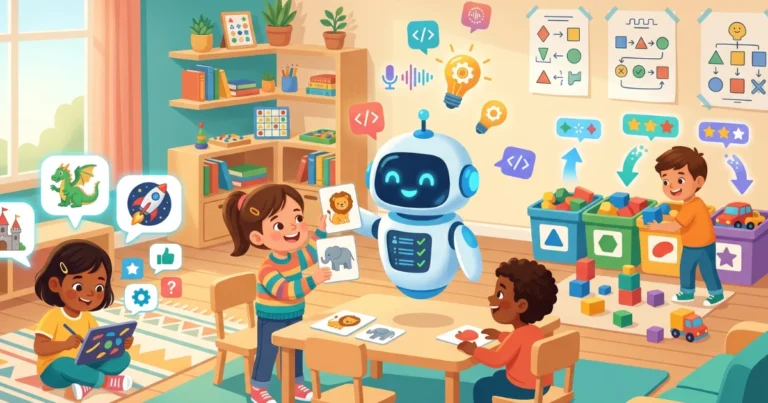
Artificial intelligence is no longer a distant concept confined to research labs and science fiction stories. It has quietly made its way into living rooms, classrooms, and the everyday routines of families around the world, and its influence on how children learn is growing more profound with every passing year. When introduced thoughtfully and with genuine care for the child’s development, AI for kids unlocks learning potential in ways that traditional education simply cannot match on its own. It transforms ordinary lessons into dynamic, living experiences that respond to each child as an individual, adapting in real time to their pace, their interests, and their unique way of making sense of the world. The old model of education, where every child sits in the same row, reads the same page, and takes the same test, is giving way to something far more human in its responsiveness and far more powerful in its results. This is not about replacing teachers or parents. It is about giving children access to a kind of personalized support that was previously available only to the most privileged few, and making it available to every child who has the opportunity to learn with it.
What learning potential really means in the age of AI
The phrase learning potential is often used as though it were a fixed quantity, something a child either has or does not have in some predetermined amount. But genuine learning potential is not a ceiling. It is a direction. It is the capacity to grow, to adapt, to absorb new ideas and integrate them with what is already known, and to keep doing that throughout an entire lifetime. In the age of AI, this understanding of potential becomes even more important because the world children are growing up into is one where the ability to keep learning, to adapt to new tools and new ideas, will matter far more than any fixed body of knowledge they memorized in school.
AI expands learning potential not by making children smarter in some abstract sense but by removing the obstacles that so often prevent children from realizing what they are already capable of. The child who struggles with reading but has a brilliant spatial mind can now access information through audio and visual formats that let their real intelligence shine. The child who grasps concepts quickly and is perpetually bored by the pace of the class can now move ahead at the speed their mind demands. The child who is too anxious to raise their hand and ask a question in front of peers can now ask an AI system as many times as they need without any social cost. These are not small improvements. They are transformative ones.
Why Ai For kids is transforming how children learn today
For most of the history of formal education, teaching has been fundamentally constrained by one unavoidable reality: one teacher, many students. This constraint forced educators to find the middle, to pitch their lessons at a level that would reach the most children without leaving too many behind or boring too many ahead. It was never ideal, but it was the best that a single human being in a room of thirty children could realistically manage. AI changes this equation entirely by making it possible, for the first time in history, to offer every child in a classroom something that feels personally designed for them.
Children today are growing up with interactive systems, voice assistants, recommendation engines, and educational games that respond and adjust in real time. They are learning not just content but a fundamentally different relationship with information itself, one where knowledge is not something handed down from an authority figure but something actively sought, explored, and constructed. AI for kids is transforming learning today not just by making it more efficient but by making it more alive, more responsive, and more deeply connected to the actual child sitting in front of the screen or holding the tablet.
How artificial intelligence removes learning barriers
Every classroom contains children who are quietly struggling with barriers that are invisible to everyone around them. A child for whom the language of instruction is not their home language, straining to follow explanations while simultaneously translating in their head. A child whose learning pace is slower than the class average, falling a little further behind each week and becoming increasingly convinced that they are simply not good enough. A child with attention challenges who cannot hold focus through a forty-five minute lecture no matter how hard they try. Traditional education, despite the best intentions of the teachers delivering it, often lacks the flexibility to address these barriers individually.
AI acts as a patient, endlessly adaptable bridge over these obstacles. It can deliver the same explanation in ten different ways until one of them clicks. It can provide text in a child’s home language alongside the language they are learning. It can break a forty-five minute lesson into ten small interactive segments that hold attention in shorter, more manageable bursts. It can offer additional practice on the specific concept a child has not yet mastered without making them feel singled out or embarrassed. By removing these barriers one by one, AI does not just help struggling children keep up. It helps them discover that they are capable of far more than the barriers were allowing them to show.
The connection between curiosity and unlocked potential
Curiosity is perhaps the most underrated force in all of education. It is not a supplement to learning or a pleasant bonus when it happens to appear. It is the engine that drives all meaningful learning forward. A curious child does not need to be pushed or prodded or rewarded with grades. They are already moving, already asking, already reaching toward the next idea with an energy that no external incentive can fully replicate. The tragedy of traditional education is that it so often extinguishes this flame rather than feeding it, replacing wonder with obligation and exploration with compliance.
AI for kids is uniquely positioned to nurture curiosity because it can meet a child exactly where their interest is and follow it wherever it leads. When a child asks a question, AI does not redirect them back to the scheduled lesson plan. It answers, and then it opens doors to related ideas, adjacent questions, and deeper explorations that the child never knew they wanted until they arrived at them. This responsiveness to curiosity creates a very different emotional experience of learning, one where following an idea feels rewarding rather than disruptive, and where asking another question is always the right thing to do.
Why traditional learning alone is no longer enough
This is not an argument against traditional education. The structure, discipline, social richness, and human mentorship that classrooms at their best provide are genuinely irreplaceable. There are things that happen between a teacher who cares and a student who trusts them that no AI system will ever replicate or should try to. But the world that today’s children will graduate into is one that looks increasingly different from the world that the current educational system was designed to prepare them for. Jobs that once required decades of specialized human expertise are being transformed by AI tools. Skills that were once considered advanced, data literacy, algorithmic thinking, the ability to collaborate effectively with AI systems, are becoming baseline competencies.
Traditional education was designed to produce workers and citizens for an industrial economy where consistency, compliance, and the ability to perform standardized tasks reliably were primary virtues. The economy that today’s children will enter rewards creativity, adaptability, critical thinking, and the ability to keep learning in the face of constant change. These are qualities that AI-enhanced education is genuinely well positioned to develop, not by replacing the best of traditional learning but by filling in the gaps that traditional methods were never designed to address.
How AI creates personalized learning experiences
Personalization is perhaps the most powerful gift that AI brings to education. For the first time, it is genuinely possible to create a learning experience that adjusts continuously to the individual child rather than requiring the child to adjust themselves to a one-size-fits-all program. AI systems do this by gathering data on how a child responds to different types of content, how long they spend on different tasks, where they make errors, where they speed through with confidence, and using that information to shape what comes next in a way that is optimally challenging without being overwhelming.
The result is a learning experience that feels less like following a curriculum and more like having a conversation with a very knowledgeable, very patient tutor who knows your strengths and weaknesses intimately and always knows just the right next thing to show you. This kind of personalization does not just improve academic outcomes, though it does that too. It changes the emotional experience of learning, making it feel less like something being done to a child and more like something the child is doing for themselves, guided by a system that genuinely understands where they are and where they need to go.
Understanding how AI adapts to each child’s pace
One of the most significant and least discussed inequalities in traditional education is the inequality of pace. Some children grasp new concepts quickly and are ready to move on almost immediately. Others need more time, more examples, more repetition before a concept truly settles into place. In a traditional classroom, neither group is ideally served. The fast learners sit waiting, growing bored and disengaged. The slower learners feel the pressure of a class moving ahead without them, often interpreting their need for more time as a personal failing rather than a natural variation in how different minds work.
AI eliminates this constraint entirely. There is no class pace for AI to maintain. There is only this child, this concept, and the question of whether understanding has been achieved. If a child masters a topic quickly, the system moves forward. If they need more time, more approaches, more practice, the system provides exactly that without judgment, without impatience, and without any of the social complexity that makes asking for help in a classroom so difficult for many children. This unconditional responsiveness to individual pace is one of the most quietly revolutionary things AI brings to children’s education.
Turning weaknesses into strengths through intelligent learning
Traditional approaches to learning weakness tend to focus on remediation, identifying what a child cannot do and drilling it repeatedly until performance improves. This approach, while sometimes effective, carries significant emotional costs. Being repeatedly confronted with your own failures, even in a supportive context, can erode confidence and create negative associations with the subject matter that persist long after the specific weakness has been addressed. AI offers a more intelligent and more humane approach to the same challenge.
Instead of simply flagging a weakness and assigning more of the same practice, well-designed AI systems analyze the nature of the weakness and identify its root cause. Is the child struggling with multiplication because they have not yet fully consolidated their addition facts? Is their reading comprehension suffering because their vocabulary is too limited to process the texts they are being given? By addressing root causes rather than surface symptoms, AI turns weaknesses into genuine learning opportunities that build understanding from the ground up rather than patching over gaps that will keep reappearing.
How Ai For kids improves cognitive development
The brain is not a fixed structure but a living, dynamic system that grows and changes in response to the experiences it encounters. The quality and variety of cognitive challenges a child engages with during their early years has a direct and lasting impact on the development of neural pathways that will serve them for the rest of their lives. AI-based learning activities, when well designed, provide exactly the kind of varied, engaging, progressively challenging cognitive stimulation that promotes healthy brain development across multiple domains simultaneously.
Memory, reasoning, attention, pattern recognition, language processing, and creative thinking are all exercised through well-designed AI learning tools in ways that are integrated and interconnected rather than isolated and artificial. A child who is navigating an adaptive story in an AI learning environment is simultaneously exercising their reading comprehension, their logical reasoning about cause and effect, their vocabulary, their working memory, and their imaginative capacity all at once. This kind of rich, multidimensional cognitive engagement is qualitatively different from the single-skill drills that characterize much of traditional educational software.
Strengthening memory through interactive learning tools
Memory research has consistently shown that information is retained far more effectively when it is encountered in a rich, interactive context than when it is presented passively for memorization. The act of retrieving information, of being tested on it, of using it actively to solve a problem or make a decision, strengthens the neural traces that make that information accessible in the future. AI learning tools leverage this understanding by designing experiences where children must actively use knowledge rather than simply receive it.
Interactive quizzes, adaptive flashcard systems, story-based problem solving, and game mechanics that require applying learned information to new situations all create the conditions for strong, durable memory formation. The interactivity is not just a motivational trick to make learning more fun, though it certainly does that. It is a cognitively significant feature that fundamentally changes how memories are encoded and how accessible they are when the child needs them later.
Boosting attention span with engaging AI activities
Attention is not a fixed resource that a child either has or lacks. It is a dynamic capacity that is profoundly influenced by the nature of what is asking for it. A child who seemingly cannot pay attention for five minutes in a traditional classroom may be perfectly capable of sustained focus for an hour when engaged with something that genuinely captures their interest. AI learning tools designed with this understanding create environments where the learning itself is interesting enough to hold attention not through artificial rewards or flashy graphics but through genuine intellectual engagement with ideas and challenges that feel meaningful.
The interactivity of well-designed AI systems also plays an important neurological role in sustaining attention. The anticipation of what comes next, the immediate feedback loop of action and response, the sense of agency that comes from making choices that actually affect outcomes, all of these features activate the brain’s reward circuitry in ways that pure passive instruction cannot. Children stay engaged not because they are forced to but because the activity is genuinely compelling, and genuine engagement is the foundation of genuine learning.
Enhancing analytical thinking from an early age
Analytical thinking, the ability to break down complex situations into component parts, identify relationships between those parts, and draw logical conclusions from the evidence available, is one of the most valuable cognitive skills a person can develop. It underlies success in mathematics, science, history, literature, and virtually every professional domain. Yet it is a skill that traditional education often fails to develop explicitly, focusing instead on content delivery and hoping that analytical capacity will develop as a byproduct. AI-enhanced learning can do much better than this.
By presenting children with challenges that explicitly require analysis, pattern detection, comparison, and logical inference, and by doing so in contexts that feel engaging and meaningful, AI tools build analytical thinking as a deliberate and central goal rather than an accidental side effect. A child who learns from an early age to approach problems analytically, to ask what do I know, what do I need to find out, and what does the evidence suggest, has developed a cognitive toolkit that will serve them across every domain of their life.
How AI helps children discover hidden talents
Every child carries within them a constellation of talents, interests, and capabilities that may never surface if they are only ever exposed to the narrow range of subjects and skills that traditional school curricula cover. A child with a extraordinary gift for musical pattern recognition may never discover it if they only ever sit in a classroom doing arithmetic and grammar exercises. A child with a deep intuitive feel for systems and logic may never know it if they are never given the chance to explore programming or engineering. AI expands the range of experiences available to children, increasing the probability that hidden talents will encounter the conditions they need to emerge.
Adaptive learning systems are particularly good at this because they continuously probe the edges of what a child knows and can do, presenting challenges that push in slightly new directions and observing how the child responds. When a child lights up in response to a particular type of challenge, when their engagement deepens and their performance accelerates, the system notices and offers more. This continuous, attentive observation of a child’s responses to varied experiences is something that even the most dedicated human teacher struggles to provide consistently across thirty students simultaneously.
Identifying strengths through adaptive learning systems
The same adaptive mechanisms that identify weaknesses in traditional skill areas also reveal strengths in ways that might not be immediately apparent from standard academic performance. A child who is average in most areas but shows an exceptional ability to recognize visual patterns, or to understand spatial relationships, or to construct logical arguments, will have those strengths surfaced by an adaptive system that is paying close attention to every interaction. This information is valuable not just for guiding further learning but for helping both the child and their parents understand the child’s genuine profile of abilities in a richer and more accurate way than a report card ever could.
Encouraging exploration of multiple interests
One of the most limiting features of traditional education is its narrowness. Children spend most of their school time on a fairly small set of subjects, and the pressure to perform in those subjects leaves little room for genuine exploration of the vast range of human knowledge and activity that lies beyond the curriculum. AI-enhanced learning can change this by making it easy and natural to follow curiosity wherever it leads, to spend an afternoon exploring how volcanoes form or how music is composed or how ancient civilizations organized their cities, without any of these explorations displacing the core academic work.
When children are free to explore multiple interests, they develop a broader base of knowledge that makes everything they learn richer and more interconnected. They also develop a healthy sense of the abundance of interesting things in the world, a sense that there is always more to discover and that learning is never exhausted. This orientation toward the world as a place of endless interesting things is one of the most valuable gifts that education can give, and AI is uniquely positioned to nurture it.
Building confidence through guided discovery
Confidence is not something that can be installed in a child by telling them they are capable. It is built through experience, through the accumulation of moments where the child tried something, worked through the difficulty, and arrived at success under their own power. AI-guided discovery creates these moments deliberately and consistently, by calibrating challenges to be hard enough to require genuine effort but achievable enough to allow success with persistence. This careful calibration of challenge and achievement is one of the most sophisticated and most valuable things that AI learning systems can do.
Each small success builds on the previous one, creating a rising arc of confidence that changes not just how a child feels about the specific subject they are studying but how they feel about themselves as a learner more broadly. A child who has discovered through repeated experience that effort leads to understanding, that sticking with a hard problem eventually pays off, has developed what researchers call a growth mindset, a belief that ability is not fixed but expandable, and this belief is one of the strongest predictors of long-term learning success that we know of.
The role of creativity in unlocking learning potential
Creativity is often treated as a soft skill, a nice-to-have that matters less than the hard academic competencies measured by standardized tests. This view is both wrong and increasingly costly. Creativity, the ability to generate novel ideas, to make unexpected connections between different domains, to approach familiar problems from entirely new angles, is one of the most economically and personally valuable capacities a person can develop. It is also one of the most endangered by educational systems that reward conformity, penalize wrong answers, and leave little room for genuine imaginative expression.
AI for kids can play a powerful role in restoring creativity to its rightful central place in education by providing tools and prompts that invite children to generate, experiment, and express rather than simply receive and repeat. When AI serves as a creative collaborator, offering suggestions, generating visual responses to text descriptions, or helping children develop stories and ideas in new directions, it amplifies children’s creative capacity rather than replacing it.
How AI expands imagination and idea generation
The blank page is one of the most intimidating things a creative child can face. The demand to generate something from nothing, without any starting point or scaffolding, blocks many children who have genuine creative ability but need a spark to get moving. AI provides that spark brilliantly, offering starting points, unexpected suggestions, visual interpretations of verbal ideas, and responses that take a child’s initial thought and show them where it might lead. This scaffolded creativity is not a crutch. It is a launchpad, and the ideas that children develop with AI assistance are genuinely their own, shaped by their choices, their aesthetic sensibilities, and their imaginative vision.
Turning simple prompts into creative breakthroughs
A single well-crafted prompt can unlock a creative flood that a child did not know they were capable of. Tell me a story about a robot who is afraid of the dark. Draw what music sounds like. Invent a creature that lives in the clouds and explain how it survives. These prompts are simple, but they create conditions in which children’s imaginations can do extraordinary things. AI systems can generate and respond to these prompts endlessly, adapting to the child’s interests and building on their responses to take the creative work in directions that are surprising, delightful, and genuinely their own.
Blending logic and creativity in learning tasks
The most interesting and most valuable cognitive work happens at the intersection of logic and creativity, where structured thinking serves imaginative goals and imagination enriches analytical problems. AI learning tools that deliberately blend these two modes, asking children to construct logical arguments in favor of creative ideas, or to find creative solutions to structured problems, develop a kind of integrated intelligence that is more powerful than either mode alone. This blending also reflects how the most interesting real-world problems actually work, where the best solutions are simultaneously rigorous and creative, systematic and imaginative.
Problem solving skills powered by Ai For kids
Problem solving is not a single skill but a family of related capacities that include identifying a problem clearly, gathering relevant information, generating possible approaches, evaluating options, implementing a solution, and reflecting on the results. Developing this full cycle of problem-solving competence requires practice with a wide variety of problems in a wide variety of contexts, and AI is extraordinarily well positioned to provide exactly that variety in a sustained, engaging, and progressively challenging way.
Learning how to approach challenges step by step
One of the most important things AI can teach children about problem solving is that complex challenges become manageable when they are broken down into smaller, more tractable steps. Many children face problems with a sense of overwhelming undifferentiated difficulty, seeing only the gap between where they are and where they need to be without any clear sense of how to cross it. AI systems can model and teach the habit of decomposition, showing children how to ask what is the first small thing I can do here and then the next, and the next, until what seemed impossible reveals itself as a sequence of achievable steps.
Using AI simulations to practice real world thinking
One of AI’s most powerful educational affordances is the ability to create simulated environments where children can practice real-world decision-making without real-world consequences. A child can practice managing a small business, planning a city, navigating a historical event, or conducting a scientific experiment in a rich, responsive simulation that gives them genuine agency and shows them the realistic consequences of their choices. This kind of experiential learning builds the kind of practical, transferable thinking skills that traditional academic exercises rarely develop, and it does so in a context that is engaging and emotionally involving rather than abstract and distant.
Developing resilience through trial and error learning
Resilience, the capacity to persist in the face of failure and to treat setbacks as information rather than defeat, is one of the most important life skills a child can develop. It is also one of the hardest to teach through traditional methods, because traditional educational settings often create powerful incentives to avoid failure at all costs. AI learning environments can change this by creating contexts where trying something, failing, learning from the failure, and trying again is not just acceptable but explicitly rewarded as the correct approach. When the system responds to a wrong answer not with a red mark but with a gentle redirect and an invitation to try again, it communicates something profoundly important about the nature of learning itself.
How AI makes complex subjects easier to understand
Some of the most important knowledge in the world is also, unfortunately, some of the most difficult to access. Advanced mathematics, the mechanisms of biological systems, the dynamics of historical change, the structure of language, these are all subjects of extraordinary power and relevance that too many children write off as simply beyond them because their first encounters with the material were confusing and discouraging. AI has a remarkable ability to find the explanation that works for a particular child, the analogy that clicks, the visualization that makes the abstract suddenly concrete.
Breaking down difficult topics into simple visuals
The human brain is extraordinarily well adapted to process visual information, far better adapted than it is to process abstract verbal descriptions of complex relationships. When a difficult concept can be represented visually, as a diagram, an animation, a color-coded map of relationships, it becomes accessible to a far larger proportion of children than the same concept presented in purely verbal or symbolic form. AI systems can generate these visual representations dynamically, adapting them to the specific concept at hand and the specific child’s level of understanding, in a way that no static textbook illustration can match.
Using interactive explanations for better comprehension
The difference between reading an explanation and interacting with one is enormous. When a child can ask follow-up questions, request a different example, slow down a process to watch it step by step, or test their understanding by making predictions and seeing whether they are correct, the explanation stops being a passive object to be consumed and becomes an active dialogue to be participated in. This dialogic quality of AI explanations is one of their most powerful features, transforming the relationship between the learner and the material from one-directional delivery to genuine two-way engagement.
Making abstract concepts more concrete and relatable
The gap between abstract academic concepts and the concrete reality of a child’s everyday experience is one of the most significant obstacles to genuine understanding in traditional education. Children learn fractions but do not connect them to sharing a pizza. They learn about historical events but do not connect them to the kind of human motivations and emotions they encounter in their own lives. AI can bridge this gap systematically by finding and generating connections between abstract concepts and concrete experiences that are genuinely relevant to the individual child’s life, making the abstract suddenly feel obvious and the distant suddenly feel close.
How Ai For kids supports different learning styles
Every child brings a unique profile of learning strengths and preferences to their educational experience. Some children process information most effectively through visual channels, thinking in images, diagrams, and spatial relationships. Others learn best through auditory input, retaining information better when they hear it explained than when they read it. Still others learn most effectively through physical interaction, through touching, building, moving, and manipulating. Traditional one-size-fits-all instruction inevitably serves some of these profiles well and others poorly. AI can serve all of them, adapting its presentation to match the learning style that works best for each individual child.
Visual learners and AI generated imagery tools
For children who think in pictures and remember things they have seen far better than things they have read or heard, AI-generated visual tools are genuinely transformative. The ability to generate a custom illustration of any concept, to visualize abstract relationships as diagrams, to represent data as beautiful and intuitive charts, gives visual learners access to their preferred mode of understanding for virtually any subject matter. A child who struggled to understand geological time scales from a textbook description may grasp it immediately when it is represented as a visual timeline that they can explore interactively.
Auditory learners and voice based AI systems
Voice-based AI systems have opened up new possibilities for auditory learners, children who absorb information more readily through listening than reading. The ability to hear an explanation, to ask a follow-up question and hear the answer, to engage with learning content through conversation rather than text, is enormously valuable for these children. It makes learning feel natural and intuitive rather than effortful and alien, and it removes the barrier that printed text represents for children who are still developing their reading fluency or who simply process language most effectively through the auditory channel.
Kinesthetic learners and interactive AI activities
Kinesthetic learners, children who learn best through physical interaction and hands-on experience, are perhaps the learning style most poorly served by traditional classroom instruction and most richly served by well-designed interactive AI activities. When learning involves touch, manipulation, construction, and physical decision-making, even if mediated through a touchscreen or interactive interface, kinesthetic learners engage at a depth that passive instruction never reaches. The interactivity of AI systems is not just a motivational feature for these children. It is a cognitive necessity, the channel through which their understanding is most deeply built.
Building digital literacy through AI exposure
Digital literacy, the ability to understand, navigate, evaluate, and create using digital tools and systems, is rapidly becoming as fundamental a life skill as reading and writing. Children who grow up with meaningful, thoughtful exposure to AI systems are not just learning specific tools. They are developing a deep, intuitive understanding of how digital systems work, what they can and cannot do, and how to interact with them critically and effectively. This understanding will serve them in virtually every domain of their adult lives, from their professional work to their civic participation to their personal decision-making.
Understanding how AI systems work in daily life
Children are already surrounded by AI systems, on their tablets, in their parents’ phones, in the apps they use for entertainment and communication. But most children interact with these systems without any conscious awareness of what is happening beneath the surface, and this lack of awareness leaves them vulnerable to manipulation, to misinformation, and to the kind of uncritical acceptance of AI outputs that can lead to poor decisions. Teaching children to understand how AI systems work, how they learn, what biases they might carry, and why they sometimes get things wrong, is an essential part of preparing them to be thoughtful, capable citizens of a world increasingly shaped by these technologies.
Learning safe and responsible technology use
Digital safety is not just about avoiding dangerous websites or keeping personal information private, though both of those things matter enormously. It is about developing a comprehensive set of attitudes and habits that allow children to navigate digital environments with judgment, discernment, and genuine understanding of the potential consequences of their digital actions. AI education is a natural context for building these habits because it introduces children to the underlying mechanics of digital systems at the same time as it gives them practical experience using them, creating opportunities to discuss safety and responsibility in a meaningful, concrete way.
Developing confidence with modern digital tools
The children who will thrive in the coming decades are those who feel comfortable and capable with digital tools, who approach new technologies with curiosity rather than anxiety, and who understand enough about how these systems work to use them critically and creatively rather than passively and uncritically. Building this confidence requires early, positive, and substantive engagement with AI systems, not just as users of finished products but as people who understand something real about what is happening underneath. This deeper familiarity transforms the relationship from one of dependence to one of genuine digital fluency.
How AI encourages independent learning
One of the most transformative effects of well-designed AI learning tools is their ability to gradually shift children from dependence on external instruction to genuine autonomous learning. This transition, from needing someone to tell you what to learn and how to learn it to being able to direct your own learning based on your own curiosity and goals, is one of the most important developmental achievements of childhood and adolescence. AI systems that are designed with this goal in mind create progressively more open-ended learning environments as children develop, offering more choice, more agency, and more responsibility for the direction of learning over time.
Letting children explore at their own pace
Self-paced learning is not just a convenience. It is a profound respect for the reality that different children develop different capacities at different rates, and that this variation is natural, healthy, and worth honoring rather than forcing into a standardized timeline. When a child is free to spend as much time as they need on a concept, to revisit it multiple times from different angles, to pause and reflect and return, the understanding they build is qualitatively different from the superficial familiarity that results from being pushed through a curriculum at a pace that serves the average rather than the individual.
Reducing reliance on constant instruction
There is a version of AI-enhanced learning that inadvertently increases children’s dependence on external guidance by providing answers too readily, always being available to solve the problem the child is struggling with before the productive struggle has had a chance to do its work. The best AI learning systems resist this temptation, using the rich data they have about each child’s capabilities to calibrate when to offer help and when to step back and let the child work. This thoughtful withholding of premature assistance is counterintuitive but essential to developing genuine independence and the confidence that comes from knowing you can figure things out yourself.
Encouraging self guided discovery and exploration
The ultimate goal of education is a learner who does not need to be educated, a person who has internalized the curiosity, the habits, the skills, and the confidence to continue learning independently throughout their entire life. AI systems that are designed with this goal in mind create experiences that gradually shift agency toward the child, inviting them to direct the learning, to choose what to explore, to decide when they understand something well enough to move on. This progressive transfer of agency is how genuine intellectual independence is built, and it is one of the most important contributions that AI can make to children’s development.
The importance of curiosity in unlocking potential
If there is a single quality that correlates most reliably with long-term learning success, intellectual fulfillment, and professional achievement, it is curiosity. Not intelligence in the narrow, measured sense, not academic performance, not even hard work, but the genuine, deep desire to understand how things work and why things are the way they are. Curiosity drives the extra reading that deepens understanding, the extra questions that reveal the interesting complexity beneath the surface, the willingness to pursue an idea into uncomfortable territory because the idea is genuinely interesting enough to be worth the discomfort.
How AI stimulates questioning and exploration
AI systems that respond to questions with more interesting questions, that answer one query in a way that naturally raises several more, that treat every child’s inquiry as the beginning of a deeper exploration rather than a transaction to be completed, actively cultivate the habit of curiosity. When a child learns that asking a question reliably leads to something more interesting than what they started with, they develop a positive feedback loop of inquiry that can sustain itself indefinitely. This is the intellectual metabolism of a lifelong learner, and AI has a unique opportunity to help children develop it.
Turning curiosity into structured learning paths
Curiosity without structure can be exhilarating but also scattered, leading children from one interesting thing to the next without building the cumulative, organized understanding that makes knowledge genuinely powerful. AI learning systems can honor curiosity while also gently channeling it into learning paths that build coherent understanding over time. When a child’s question about dinosaurs leads naturally to an exploration of geological time, which leads to chemistry, which leads to the origins of life, the child is not being dragged through a curriculum. They are following their own curiosity along a path that has been thoughtfully designed to build genuine comprehension at every step.
Encouraging “what if” thinking in children
Hypothetical thinking, the ability to imagine how things might be different, to consider counterfactuals, to ask what would happen if, is one of the most sophisticated and most valuable cognitive capacities that children can develop. It is the foundation of scientific reasoning, of historical understanding, of empathy, and of creative problem solving. AI systems can cultivate this habit by consistently responding to children’s statements and questions with gentle what if challenges that invite them to consider alternatives, to think beyond the obvious, and to discover that reality is always more complex and more interesting than it first appears.
Real world applications of Ai For kids learning
The knowledge and skills that children develop through AI-enhanced learning are not confined to academic performance. They are directly and immediately relevant to the real world that children already inhabit and to the world they will enter as adults. Digital literacy, analytical thinking, creative problem solving, independent learning, and the ability to work effectively with AI tools are not future skills. They are present-tense competencies that are already shaping outcomes in every professional domain and that will only become more central as AI continues to develop.
How AI connects education to everyday life
The most powerful learning always happens when the connection between what is being learned and how it applies to real life is clear and compelling. AI systems can make these connections systematically by grounding abstract concepts in concrete examples drawn from the child’s actual experience, by showing how the math they are learning applies to the games they play, how the science they are studying explains the weather they experience, how the history they are exploring shaped the world they live in. This constant bridging between academic content and lived experience transforms learning from an abstract exercise into a genuinely meaningful activity.
Preparing children for future careers and industries
The careers that today’s children will pursue as adults will, in many cases, involve working alongside AI tools in ways that we cannot yet fully predict or describe. What we can say with confidence is that the children who will thrive in this environment are those who understand AI at a meaningful level, who are comfortable with digital tools, who can think analytically and creatively, and who know how to learn quickly in response to rapidly changing circumstances. These are precisely the capacities that thoughtful AI-enhanced education builds, and building them early creates compounding advantages that will serve children throughout their entire careers.
Building skills relevant for a digital economy
Digital fluency is already becoming a baseline requirement across an enormous and expanding range of occupations, not just in obviously technical fields but in marketing, healthcare, education, law, finance, and virtually every other domain of professional activity. Children who develop genuine digital fluency early, who understand not just how to use digital tools but how they work and why they make the decisions they do, will enter the workforce with a significant advantage over those who have only surface-level familiarity with technology. AI-enhanced education is one of the most effective ways to build this kind of deep digital literacy from an early age.
How AI improves academic performance
The academic performance improvements associated with well-implemented AI learning tools are real and documented. When children receive the right level of challenge, immediate feedback on their performance, explanations calibrated to their current level of understanding, and the opportunity to practice skills in a variety of engaging contexts, they learn more and retain it better than children taught through traditional methods alone. These improvements are not marginal. Across a wide range of subjects and age groups, AI-enhanced learning consistently produces meaningfully better outcomes when implemented thoughtfully and used as a complement to good human teaching rather than a replacement for it.
Supporting math, science, and language learning
Mathematics, science, and language are the subjects that open the most doors in children’s academic and professional futures, and they are also the subjects where AI support is currently most developed and most effective. In mathematics, AI can provide unlimited practice with immediate feedback, identify misconceptions at their root, and present concepts through multiple representations until one clicks. In science, simulations and interactive models make abstract processes tangible. In language learning, AI conversation partners provide the low-pressure speaking practice that is so essential to fluency development and so hard to provide in traditional classroom settings.
Providing instant feedback for faster improvement
Feedback is the engine of learning, and the faster and more specific the feedback, the faster the learning. Traditional educational settings can rarely provide feedback quickly enough to be optimally useful. A child makes an error in their homework, submits it, and receives it back days later with corrections. By that point, the mental context in which the error was made has long since faded, and the feedback lands in a vacuum, informative but not nearly as powerful as it would have been if it had come seconds after the mistake. AI provides that instant, specific feedback, catching errors in real time and offering explanations while the child’s thinking about the concept is still fresh and active.
Helping children correct mistakes in real time
The value of real-time error correction goes beyond simply knowing what went wrong. When feedback comes immediately, children can compare their incorrect thinking directly with the correct approach while both are present in their working memory, which dramatically accelerates the process of understanding and correcting the misconception. This is why AI tutoring systems that provide rich, explanatory real-time feedback are so much more effective than systems that simply mark answers right or wrong. The explanation of why something was wrong, delivered at the exact moment the child needs it, is where the real learning happens.
Social and emotional benefits of AI learning
The benefits of AI-enhanced learning extend well beyond academic performance into the social and emotional dimensions of children’s development. Confidence, resilience, collaboration, and the management of frustration are all areas where thoughtfully designed AI learning environments can make a genuine positive difference. These social and emotional competencies are not separate from academic learning. They are the foundation on which all learning rests, and they deserve to be taken as seriously as any academic subject.
Building confidence through achievement based learning
Every time a child successfully completes a challenge that was genuinely difficult for them, something important happens not just in their skill set but in their self-concept. They update their understanding of what they are capable of, and this updated self-concept shapes every subsequent learning experience. AI systems that are calibrated to provide this experience of earned success consistently, that make the challenges hard enough to be real but achievable enough to allow success with persistence, are doing something profoundly important for children’s confidence and their long-term relationship with learning.
Encouraging collaboration with digital tools
AI learning does not have to be a solitary experience. Many of the most effective AI-enhanced activities are designed for groups of children working together, using AI as a shared resource and collaborative partner rather than an individual tutor. When children collaborate around AI tools, they develop not just their individual skills but their ability to communicate their thinking, to build on each other’s ideas, to disagree productively, and to arrive at solutions through collective intelligence. These collaborative skills are among the most important that children can develop for their future careers and civic lives.
Reducing fear of failure through guided practice
Fear of failure is one of the most powerful inhibitors of learning and one of the most common sources of lasting educational damage. Children who are afraid to try because they are afraid to fail will consistently underperform relative to their actual ability, and they will miss the most important lessons that failure has to offer. AI learning environments can systematically reduce this fear by creating contexts where trying and failing is explicitly framed as the correct approach, where the system responds to incorrect answers with warmth and constructive guidance rather than judgment, and where the emotional experience of getting something wrong is consistently neutral or even positive.
How parents can support Ai For kids learning
Parents are not just bystanders in their children’s AI learning journey. They are active participants whose attitudes, involvement, and guidance shape the experience profoundly. A parent who approaches their child’s AI learning with genuine curiosity and enthusiasm, who sits alongside them and asks questions about what they are discovering, who connects what the child is learning to conversations and experiences in everyday family life, multiplies the impact of every AI learning activity many times over. Conversely, a parent who is skeptical, dismissive, or simply absent from the learning process, even if they are providing access to excellent tools, leaves much of the potential value unrealized.
Creating a supportive learning environment at home
The physical and emotional environment in which children learn at home has a significant impact on the quality and depth of their learning. A dedicated space, however modest, that is associated with focused, enjoyable learning activity signals to the child that this is a time and place for something valuable and worthwhile. Freedom from interruption, access to whatever materials the activities require, and the presence of an engaged adult who can celebrate successes and support through challenges all contribute to a learning environment that amplifies the effectiveness of AI tools rather than constraining it.
Encouraging exploration without pressure
The single most counterproductive thing a parent can do in relation to their child’s AI learning is to turn it into a performance. Children are exquisitely sensitive to the difference between exploring because they are genuinely curious and performing because someone is watching and evaluating. As soon as AI learning activities become associated with parental approval and disapproval, they lose the quality of free exploration that makes them most effective and most enjoyable. The parent’s job is to create the conditions for genuine exploration and then to step back far enough that the child feels free to follow their curiosity wherever it leads.
Balancing guidance with independence
The art of supporting a child’s learning lies in finding the moving target between too much help and too little. Too much guidance and the child never develops the independence and confidence that come from figuring things out themselves. Too little and they can become frustrated and discouraged, associating the difficulty with inability rather than with the normal challenge of learning something genuinely new. AI systems help with this calibration by providing scaffolded support that adjusts to the child’s level, but parents play an irreplaceable role in reading the emotional dimension of this balance and adjusting their involvement accordingly.
Best practices for using AI in education
Getting the most out of AI tools in education requires more than simply providing access to good software. It requires intentional choices about how AI tools are integrated into a broader learning environment that includes human interaction, physical activity, creative expression, and direct engagement with the real world. AI is a powerful tool, but like all powerful tools, its effectiveness depends enormously on how thoughtfully it is used.
Choosing age appropriate AI tools
Not all AI learning tools are created equal, and the difference between age-appropriate and age-inappropriate tools can be enormous in terms of both effectiveness and safety. Age-appropriate tools are designed with the cognitive, emotional, and social developmental stage of the target age group in mind. They present challenges at the right level of complexity, they use language and concepts that are accessible without being condescending, they are designed for safety and privacy, and they create the kind of experiences that genuinely support development at that particular stage rather than simply being simplified versions of adult tools.
Setting healthy screen time boundaries
The question of screen time is one that generates enormous anxiety among parents, and AI learning tools add a layer of complexity to this conversation. The key insight is that not all screen time is equivalent. An hour spent in genuine interactive learning with a well-designed AI educational tool is categorically different from an hour spent passively consuming entertainment content, even though both register as screen time on a parental control app. The goal should not be to minimize screen time as such but to ensure that screen time is high quality, genuinely engaging, and balanced with plenty of time for physical activity, face-to-face social interaction, and screen-free creative play.
Mixing AI learning with offline activities
The richest learning environments for children are those that weave together digital and physical experiences in ways that make each richer through its relationship with the other. The concepts encountered in AI learning activities come to life when they are followed up with physical experiments, outdoor exploration, creative projects, and real-world conversations. The physical experiences become more meaningful when they are framed and reflected on through the concepts and vocabulary that AI learning has provided. This integration of digital and physical learning is not just good pedagogical practice. It is the most authentic way to develop the full range of cognitive and physical intelligences that children possess.
Common challenges in unlocking learning potential
Even the most well-designed AI learning program will encounter challenges, and being prepared for them makes it far easier to navigate them without losing momentum or enthusiasm. The challenges are real but manageable, and understanding them in advance is the first step toward addressing them effectively.
Avoiding overdependence on AI tools
One of the most important risks to manage in AI-enhanced education is the risk of creating a kind of learned helplessness, a habit of turning to AI for every answer before attempting to think things through independently. Children who learn to reach for AI assistance reflexively, before they have made a genuine effort to work through a challenge themselves, develop a dependence that ultimately limits rather than expands their capabilities. The antidote is consistent, intentional emphasis on the value of independent thinking, combined with AI systems designed to provide scaffolded support rather than simple answers.
Preventing distraction from digital overload
Digital environments are designed, at a fundamental level, to capture and hold attention. Every notification, every recommendation, every algorithmically optimized piece of content is competing for the same finite cognitive resource. For children whose attention is still developing and whose impulse control is still maturing, this environment poses genuine challenges that thoughtful parents and educators need to take seriously. Focused, intentional use of AI learning tools, with clear boundaries around time and scope, is essential to ensuring that digital learning is genuinely educational rather than simply another form of digital distraction dressed up in educational clothing.
Ensuring meaningful engagement with content
There is a version of AI-enhanced education that is impressive-looking but educationally shallow: children interacting with colorful, engaging interfaces, accumulating points and badges, moving through levels, while the actual depth of their understanding remains superficial. Meaningful engagement is not just engagement. It is engagement that results in genuine understanding, in changed thinking, in the ability to apply what has been learned to new situations. Distinguishing between these two kinds of engagement and consistently choosing the latter over the former is one of the most important responsibilities of parents and educators using AI learning tools.
How to measure learning progress with AI
One of the significant advantages of AI learning systems over traditional educational methods is their ability to generate rich, continuous data about how a child is learning, not just what they have learned. This data, used wisely, provides a far more nuanced and accurate picture of a child’s development than any periodic test or grade report can offer. But using this data wisely requires understanding what it is actually measuring and what it means for the child’s broader development.
Tracking improvement through interactive feedback
The most valuable form of progress tracking is not the summary statistics that AI dashboards typically display but the pattern of changes in how a child responds to challenges over time. Are they attempting harder problems than they were a month ago? Are they recovering from errors more quickly? Are they asking more sophisticated questions? These qualitative indicators of growth are as important as any quantitative measure, and parents who pay attention to them develop a rich, accurate understanding of how their child is developing that no report card can fully capture.
Observing behavioral and cognitive growth
The most meaningful evidence of genuine learning is visible not in test scores but in the way a child thinks and behaves in their ordinary life. A child who has genuinely internalized analytical thinking will approach problems analytically in unrelated contexts. A child who has developed confidence as a learner will tackle new challenges with eagerness rather than anxiety. A child who has built genuine digital literacy will engage with technology critically and thoughtfully rather than passively and uncritically. These behavioral and cognitive changes are the real indicators of learning success, and noticing and celebrating them is one of the most important things parents can do.
Celebrating small milestones in learning
In the long journey of education, it is easy to become so focused on the distant destination that the many smaller achievements along the way go unnoticed and uncelebrated. But these small milestones matter enormously, both for the child’s motivation and for their developing sense of themselves as a capable, growing person. Every time a child masters a concept they previously struggled with, solves a problem they could not have solved last week, or demonstrates a skill they have built through effort and persistence, something worth celebrating has happened. AI systems can track and surface these moments, and parents can honor them in ways that build the kind of intrinsic motivation that sustains learning over a lifetime.
Future of learning with Ai For kids
We are at an early and genuinely exciting moment in the integration of AI into children’s education. The tools available today, as impressive as they already are, represent only the beginning of what will be possible as AI systems become more capable, more nuanced, and more deeply integrated into every aspect of the learning environment. The children who are growing up with these tools now are, in a real sense, the pioneers of a new educational paradigm, and the experiences they are having today are shaping the expectations, habits, and capabilities that will define what education means for generations to come.
How education systems are evolving with AI
School systems around the world are grappling with how to integrate AI tools into their pedagogical approaches in ways that genuinely enhance learning without displacing the irreplaceable human elements of education. The most thoughtful implementations treat AI as a powerful tool that extends what human teachers can do rather than as a replacement for human teaching. They use AI to personalize practice and feedback while preserving human teachers for the mentorship, inspiration, moral guidance, and social modeling that no AI system can provide. Getting this balance right is one of the central educational challenges of our time.
Emerging technologies in personalized learning
The personalization capabilities of AI learning systems are advancing rapidly. Systems that today can adapt the difficulty and format of practice problems will soon be able to model a child’s complete cognitive profile across all subjects, predict where they are likely to encounter difficulty before they encounter it, and recommend learning experiences that address those challenges proactively. The integration of natural language interaction, computer vision, and emotional AI will create learning environments that are responsive not just to a child’s academic performance but to their emotional state, their engagement level, and even their physical energy in the moment.
The next generation of AI powered classrooms
The classroom of the near future will look and feel quite different from the classroom of today, and the changes will not be primarily about the presence of more screens or more devices. They will be about a fundamentally different relationship between teachers, students, and learning content, one where every child has access to a level of personalized support that was previously impossible, where teachers are freed from the most repetitive aspects of their work to focus on the human elements that only they can provide, and where the learning environment is continuously responsive to every student’s needs in real time. This classroom is not a distant fantasy. Its building blocks are already in place.
Conclusion on Ai For kids unlocks learning potential
Artificial intelligence, when brought into children’s learning with care, intention, and genuine understanding of what education is for, has the potential to be one of the most transformative forces for positive change in the history of human learning. It does not promise to make education easy or effortless, because genuine learning never is. What it promises is that the effort children put into learning will be better directed, better supported, more personally relevant, and more likely to result in genuine understanding and lasting capability. Every child who grows up with access to thoughtfully designed AI learning tools has access to a kind of support that genuinely expands what they are capable of becoming.
Why AI is a catalyst for lifelong learning growth
The most important thing that education can give a child is not knowledge of any specific subject but the capacity and the desire to keep learning long after their formal education has ended. AI-enhanced education, at its best, builds exactly this. By making learning genuinely engaging, by calibrating challenges to the child’s actual level, by celebrating curiosity and rewarding persistence, and by gradually transferring ownership of the learning process to the learner themselves, AI creates the conditions for a lifelong learning orientation that is the most valuable educational outcome of all.
Encouraging continuous curiosity and development in children
When curiosity is nurtured from the earliest years, when children grow up in environments where questions are celebrated, where exploration is supported, and where the act of discovering something new is consistently one of the most rewarding experiences available, curiosity does not remain a childhood trait that fades with age. It deepens, broadens, and becomes the organizing principle of an intellectual life that continues to grow and flourish decade after decade. This is the deepest promise of AI-enhanced education for children, not just better test scores or more efficient skill development, but the cultivation of minds that will remain curious, capable, and alive to the wonder of the world for as long as they live.