How to Keep Kids Busy at Home Without Screens (25 free activities for kids)
Table of Contents
How to Keep Kids Busy at Home Without Screens (25 free activities for kids)
Every parent knows the moment. You need 30 minutes to make a phone call, finish some work, or simply breathe. You look at your child and they look back at you with that expression — the one that says I am bored and I need you to fix it right now.
And the easiest solution is always right there. A tablet. A phone. The television. Thirty seconds and the problem is solved.
But deep down most parents know that screens are a short term solution with long term costs. Too much screen time affects sleep, attention spans, physical activity, creativity, and the ability to self-entertain — the very skill that would solve the boredom problem in the first place.
The good news is that keeping kids busy without screens is genuinely possible — and it gets easier the more you build the habits and the environment that support it. This guide gives you 25 practical proven ideas that work for children of all ages, organized by type so you can find exactly the right activity for the moment.
Why Screen-Free Time Matters More Than Ever
Before we dive into the activities it is worth understanding what children actually gain from screen-free time — because knowing the why makes it easier to hold the line when screens feel like the easier option.
Self-directed play develops executive function: When children are left to find their own entertainment without a screen providing constant stimulation they are forced to use their imagination, make decisions, solve problems, and manage frustration. These are the building blocks of executive function — the cognitive skills that predict academic success, emotional health, and life satisfaction better than almost any other factor.
Boredom is productive: Many parents treat boredom as an emergency to be solved immediately. But research consistently shows that boredom is actually the gateway to creativity. Children who are allowed to be bored — and supported through it rather than rescued from it — are more creative, more self-reliant, and better at entertaining themselves over time.
Physical development requires movement: Screen time is sedentary. Growing bodies need movement — not just for physical health but for brain development, coordination, sensory processing, and emotional regulation. Every hour of screen-free active time is an investment in your child’s physical and cognitive development.
Attention spans need exercise: Screens provide constant rapid stimulation that requires very little sustained attention from the viewer. The real world — books, crafts, building, imaginative play — requires and builds genuine sustained attention. Screen-free activities are literally training your child’s ability to focus.
Part 1 — Creative Activities
Creative activities are among the most effective screen-free options because they are engaging, self-directing, and produce a tangible result that children feel proud of.
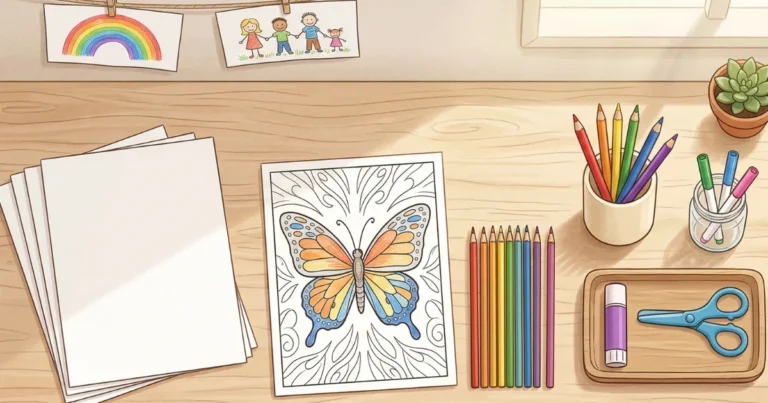
1. Coloring Pages Keep a stack of free printed coloring pages readily available at all times. Coloring is one of the most reliably effective screen-free activities for children of all ages — toddlers through teens. It develops fine motor skills, builds focus, encourages color creativity, and produces a finished result children can display with pride. The key is having pages printed and ready before boredom strikes.
2. Drawing and Sketching Provide a dedicated drawing pad and a selection of pencils, markers, and crayons. Give open-ended drawing prompts — draw your dream treehouse, draw what you would look like as a superhero, draw the most delicious meal you can imagine. Open-ended prompts spark imagination far more effectively than asking children to draw something specific.
3. Collage Making Collect old magazines, newspapers, wrapping paper scraps, fabric pieces, and natural materials like leaves and flowers. Give children glue, scissors, and a piece of card and let them create collages. Collage is wonderfully inclusive — children of all ages and skill levels can participate successfully and the results are always uniquely personal.
4. Clay and Playdough Sculpting Playdough for younger children and air-dry clay for older ones provides hours of tactile creative engagement. Give children simple prompts — make your favorite animal, build a tiny world, sculpt something that makes you happy — and then step back. Sculpting builds fine motor skills, spatial reasoning, and creative confidence.
5. Homemade Book Making Fold several sheets of paper together and staple them in the middle to make a simple book. Give children the book and ask them to write and illustrate their own story. Even children who cannot yet write can dictate a story for a parent to write while they draw the illustrations. The finished book becomes a treasured possession.
Part 2 — Educational Activities
Screen-free time does not have to be purely recreational. These activities build real skills while keeping children genuinely engaged.
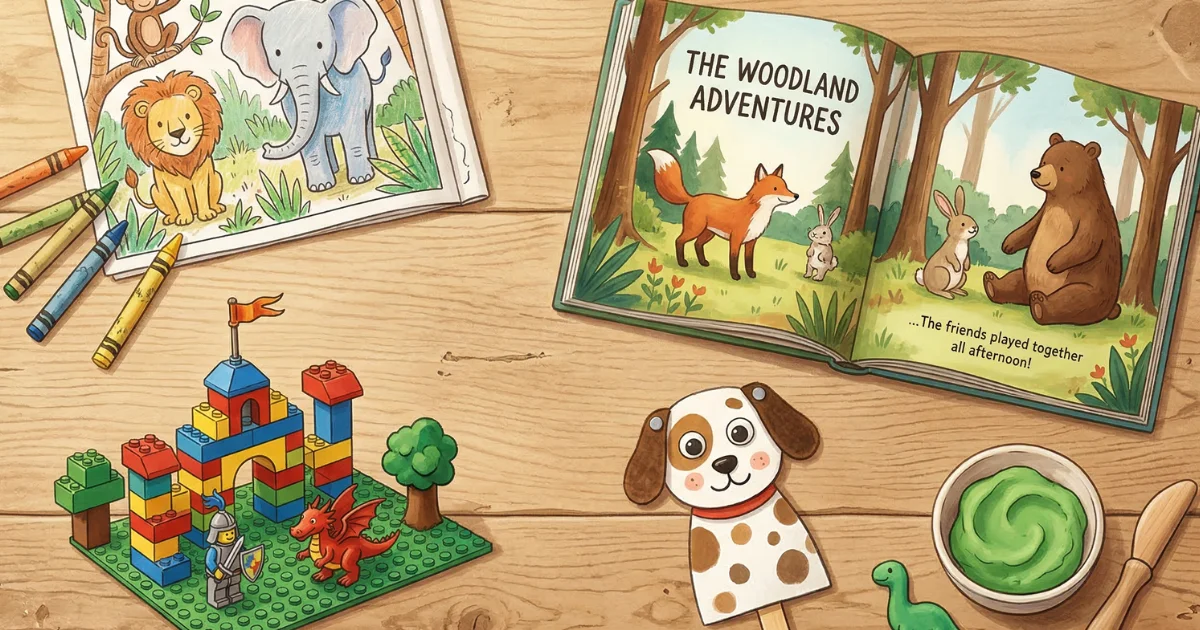
6. Building with Blocks or LEGO Building toys are among the most developmentally rich screen-free activities available. They develop spatial reasoning, engineering thinking, fine motor skills, creative problem solving, and the satisfying experience of building something that exists in three dimensions. Give children open-ended building challenges — build the tallest tower possible, build a bridge that can hold a book, build a home for your toy animal.
7. Puzzles Puzzles build concentration, spatial reasoning, problem solving, and the important life skill of working persistently toward a goal. Match the puzzle complexity to your child’s age — simple large piece puzzles for toddlers, increasingly complex puzzles for older children. The satisfaction of completing a puzzle is a powerful dopamine reward that motivates children to attempt the next one.
8. Reading Building a reading habit is one of the most valuable investments you can make in your child’s development. Create a comfortable reading nook — a bean bag, a pile of cushions, a cozy corner with good lighting — and stock it with books at and slightly above your child’s current reading level. Let children choose their own books within a curated selection. Choice creates ownership and ownership creates engagement.
9. Educational Card Games Card games like Snap, Go Fish, Memory, and Uno build number recognition, color recognition, matching skills, turn taking, and strategic thinking — all while being genuinely fun. Keep a selection of card games in an easily accessible location so children can initiate them independently.
10. Nature Journaling Give children a notebook designated as their nature journal. Encourage them to go into the garden or look out the window and observe something in nature — a bird, a plant, an insect, a cloud formation. Draw it, describe it, and try to find its name. Nature journaling builds scientific observation skills, writing skills, and a lifelong connection to the natural world.
Part 3 — Physical Activities
Children need to move. These screen-free physical activities channel energy productively while building strength, coordination, and physical confidence.
11. Indoor Obstacle Course Use cushions, blankets, chairs, and rolled up towels to build an indoor obstacle course. Crawl under the table, jump over the cushion, balance along the line of tape, crawl through the blanket tunnel. Time your child and let them try to beat their own record. Indoor obstacle courses burn enormous amounts of energy and can be reconfigured endlessly.
12. Dance Party Put on music and dance. Simple but extraordinarily effective for burning energy, lifting mood, and connecting as a family. Let your child choose the music. Make up silly dances together. This works for all ages from toddlers to teens — though the music selection may vary significantly.
13. Garden Exploration Send children outside with a magnifying glass and a notebook and ask them to find ten different living things in the garden. An ant, a spider, a worm, a butterfly, a flower, a bee. Document each one with a drawing and a description. Garden exploration is free, educational, physically active, and endlessly varied.
14. Yoga for Kids Children’s yoga is a wonderful screen-free physical activity that also develops body awareness, balance, flexibility, and calm. There are many simple children’s yoga poses with animal names — the cat pose, the downward dog, the cobra, the tree — that children find amusing and engaging. Practicing a simple sequence of five or six poses takes about 15 minutes and leaves children calmer and more focused.
15. Hula Hooping and Jump Rope Classic physical play equipment like hula hoops and jump ropes are perennially effective for burning energy outdoors. Children naturally invent games and challenges with these simple tools — counting how many jumps before a miss, trying to keep the hula hoop going for longer, inventing new tricks.
Part 4 — Imaginative Play Activities
Imaginative play is the most developmentally important type of screen-free play for young children. It builds language, social skills, emotional intelligence, and creative thinking simultaneously.
16. Dramatic Play and Dressing Up A simple box of dressing up clothes — old scarves, hats, jewelry, shoes, and fabric pieces — unlocks hours of imaginative play. Children naturally create elaborate scenarios, assign roles, negotiate storylines, and practice social interactions through dramatic play. This is some of the richest learning that happens in childhood.
17. Puppet Shows Make simple puppets from socks, paper bags, or wooden spoons and put on a puppet show. Give children a simple prompt — the puppets are best friends who have an argument and need to make up — and let them take it from there. Puppet shows build language, narrative thinking, emotional understanding, and performance confidence.
18. Building a Fort Blanket forts are timeless for a reason. The process of designing and building a fort develops spatial reasoning and engineering thinking. The fort itself becomes a private creative space that children inhabit for hours — reading, drawing, playing, and imagining inside their creation.
19. Sensory Play For younger children sensory play — water play, sand play, kinetic sand, slime, rice bins, or dried pasta bins — provides rich tactile stimulation that supports sensory development and provides deeply satisfying screen-free engagement. Sensory play is messy but the engagement it produces is extraordinary.
20. Storytelling Games Sit together and play the one sentence story game. One person says the first sentence of a story. The next person adds the second sentence. Continue around the family adding one sentence at a time. The resulting stories are wonderfully silly and children absolutely love the collaborative creative process.
Part 5 — Practical Life Activities
Involving children in real household tasks is one of the most underused strategies for screen-free engagement. Children feel valued and capable when they contribute meaningfully to the household.
21. Cooking and Baking Together Children of almost all ages can participate in some aspect of cooking or baking — washing vegetables, measuring ingredients, stirring batter, decorating cookies, arranging ingredients on a pizza. Cooking together builds math skills, science understanding, fine motor skills, independence, and the deeply satisfying experience of creating something edible from scratch.
22. Gardening Give children their own small patch of garden or a pot to grow something — herbs, cherry tomatoes, sunflowers, or any fast growing plant. The responsibility of watering, the anticipation of growth, and the satisfaction of harvest make gardening one of the most complete developmental activities available.
23. Sorting and Organizing Young children love sorting and organizing tasks — sorting buttons by color, organizing a bookshelf by size, arranging a collection of rocks by shape. These tasks build concentration, categorization skills, mathematical thinking, and a genuine sense of contribution to the household.
24. Simple Sewing and Craft Projects Older children aged 8 and up can learn simple sewing stitches and use them to make small practical items — a simple drawstring bag, a stuffed animal, a decorative pillow. Learning a practical craft skill is deeply satisfying and provides screen-free engagement that builds genuine capability.
25. Letter and Card Writing Give children writing materials and ask them to write a letter or draw a card for someone they love — a grandparent, a cousin, a friend they have not seen recently. The act of writing for a real recipient with the intention of sending the letter gives purpose and motivation to the activity. The response they receive when the letter arrives reinforces the value of the effort.
How to Make Screen-Free Time Sustainable
Having a list of 25 activities is helpful but the real challenge for most parents is making screen-free time a sustainable habit rather than an occasional effort. Here are the strategies that make the biggest difference:
Prepare in advance: Screen-free activities succeed when everything is ready before boredom strikes. Print coloring pages in advance. Keep a collage box stocked. Have the playdough accessible. The activities that require no preparation from the parent are the ones that get used consistently.
Create a Yes Space: Designate one area of your home as a yes space — a place where children are free to use any materials available without asking permission first. Stock this space with age-appropriate creative and educational materials. When children have autonomous access to engaging materials they develop the habit of self-directed activity naturally.
Start with short periods: If your children are accustomed to significant screen time do not try to replace all of it immediately. Start with one hour of screen-free time per day — perhaps after school or before dinner. Build the habit gradually and increase the screen-free period over weeks as children develop their capacity for self-directed engagement.
Be present at the beginning: Many parents make the mistake of expecting children to immediately engage independently with screen-free activities. Most children need a parent to initiate and participate in the activity for the first few minutes before they can sustain it independently. Invest 5 minutes of your attention at the beginning of an activity and you will often get 30 minutes of independent engagement in return.
Avoid rescuing boredom immediately: When your child says they are bored resist the impulse to immediately solve it for them. Wait. Observe. If they are genuinely struggling after 10 to 15 minutes offer a suggestion from this list. But give boredom a chance to do its work first — creative self-direction almost always emerges from boredom when screens are not available as the default solution.
Frequently Asked Questions
How much screen time is appropriate for children? Current guidelines from major pediatric organizations suggest no screen time for children under 18 to 24 months except video calls, one hour per day of high quality content for children aged 2 to 5, and consistent limits with prioritization of sleep and physical activity for children aged 6 and older. However every family is different and the quality and context of screen time matters as much as the quantity.
My child refuses to do anything without screens — where do I start? Start with activities that have the highest natural appeal for your specific child. If they love animals start with animal coloring pages or nature journaling. If they love building start with LEGO challenges. If they love cooking start there. Match the first screen-free activities to existing passions rather than introducing completely new interests.
How do I handle the transition period when children are difficult about screen limits? The transition period when screens are reduced is genuinely difficult and can last one to two weeks. Children who have become accustomed to constant screen stimulation will find the quieter pace of screen-free activities frustrating at first. Persist calmly and consistently. The discomfort is temporary and the development of self-directed play skills on the other side is worth it.
At what age can children sustain screen-free activities independently? Most children aged 4 and up can sustain screen-free activities independently for 15 to 30 minutes when the activity matches their developmental level and interests. This capacity grows with practice. Children who regularly engage in screen-free play develop longer attention spans and greater capacity for self-direction over time.
What if I need longer than 30 minutes of uninterrupted time? Combine multiple activities into a screen-free activity sequence. Set up three or four different activity stations — a coloring station, a building station, a sensory play station, a reading nook — and let your child move between them naturally. Multiple stations extend screen-free engagement significantly compared to a single activity.
— Lina, Daily Coloring Pages