
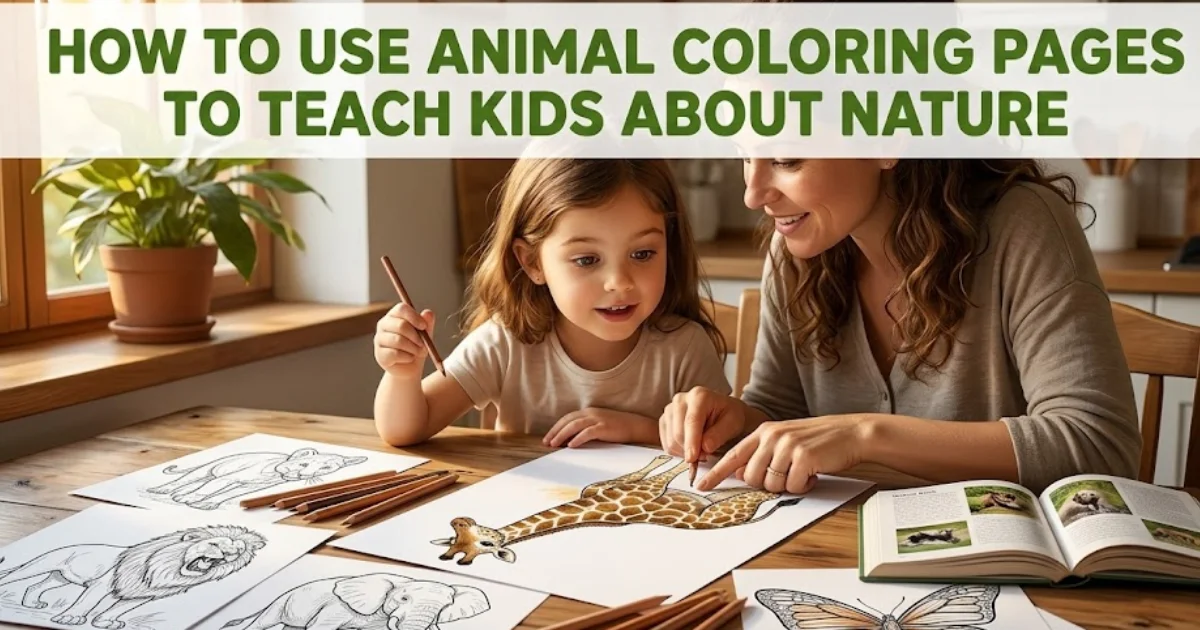
How to Use Animal Coloring Pages to Teach Kids About Nature (Complete Guide)
Table of Contents
How to Use Animal Coloring Pages to Teach Kids About Nature (Complete Guide)
A child who colors a lion does not just fill in a shape with yellow and brown. If you guide the experience thoughtfully that child learns where lions live, what they eat, why they are endangered, and why they matter to the ecosystem they call home.
Animal coloring pages are one of the most underused educational tools available to parents and teachers. They are free, accessible, endlessly adaptable, and they work for every age from toddlers to teenagers. The act of coloring slows children down enough to really look at an animal — its shape, its features, its unique characteristics — in a way that a quick video or a passing glance at a picture book never quite achieves.
This complete guide shows you exactly how to turn a simple animal coloring page into a rich, meaningful nature education experience — at home, in the classroom, and everywhere in between.
Why Animal Coloring Pages Work So Well for Nature Education
Before we get into the specific activities it is worth understanding why this combination works so powerfully.
Coloring creates focused attention: When a child is coloring they are still. They are looking carefully at the animal on the page. They notice details they would normally skip past — the pattern on a butterfly’s wing, the texture of an elephant’s skin, the shape of a bird’s beak. This careful observation is the foundation of all scientific learning.
Emotional connection through creativity: A child who has spent 20 minutes carefully coloring a sea turtle has an emotional investment in that animal that a child who watched a 2 minute video does not. Emotional connection is what transforms information into genuine care — and genuine care is what eventually becomes environmental values and conservation behavior.
Coloring accommodates all learning styles: Visual learners love the images. Kinesthetic learners love the physical act of coloring. Auditory learners can listen to facts about the animal while they color. Coloring pages are one of the rare educational tools that work simultaneously for all three major learning styles.
No pressure environment: Coloring pages create a relaxed low pressure environment where children feel safe to ask questions, make observations, and share thoughts. Some of the best nature conversations happen naturally while children are quietly coloring together.
Accessible and free: Unlike expensive field trips, zoo visits, or nature documentaries that require screens, coloring pages require nothing more than a printed page and something to color with. They work at the kitchen table, in the classroom, in the car, and in waiting rooms.
Part 1 — Activities for Toddlers and Preschoolers Ages 3 to 5
Young children learn best through simple sensory experiences paired with clear language. At this age the goal is not information transfer — it is building wonder, vocabulary, and the beginnings of a relationship with the natural world.
Activity 1 — Color and Name
How it works: Give your toddler a simple bold animal coloring page — a cat, a dog, a duck, or a fish. As they color name the animal clearly and repeat it. Point to different parts of the animal and name those too. The tail. The ears. The eyes. The feet.
What it teaches: Animal names, body part vocabulary, the concept that different animals have different features.
Extension: Make the animal’s sound together while coloring. A cow says moo. A duck says quack. Connect the printed image to the real sound.
Activity 2 — Where Does This Animal Live
How it works: After coloring a simple animal such as a fish or a bird ask your child — where do you think this animal lives? Help them answer — in the water, in the sky, in the forest, on the farm. Draw a simple background together on the coloring page — blue wavy lines for water, green lines for grass.
What it teaches: The concept of habitats — that different animals live in different places that suit their needs.
Extension: Group several colored animal pages into habitat families. All the ocean animals together. All the forest animals together. All the farm animals together.
Activity 3 — Big and Small
How it works: Print coloring pages of animals of very different sizes — an elephant and a mouse, a whale and a goldfish, a giraffe and a ladybug. Color them together and then compare. Which one is the biggest? Which is the smallest?
What it teaches: Size comparison, vocabulary of scale, the concept that animals come in an enormous range of sizes.
Extension: Try to find something in your home that is about the same size as each animal. A toy car is about as big as a mouse. The sofa is about as long as a dolphin.
Part 2 — Activities for Early Elementary Ages 6 to 8
Children in this age group are ready to absorb real factual information about animals. They love surprising facts and are beginning to develop genuine opinions and preferences.
Activity 4 — The Animal Fact File
How it works: While your child colors an animal page read them three to five interesting facts about that animal. After coloring ask them to tell you back one fact they remember. Write it on the back of the colored page.
What it teaches: Factual knowledge about animals, listening comprehension, memory recall.
Example facts to share while coloring a giraffe:
- Giraffes are the tallest animals on Earth — they can grow up to 6 meters tall
- A giraffe’s tongue is about 45 centimeters long and is bluish-black in color
- Giraffes only sleep about 30 minutes per day — one of the shortest sleep periods of any mammal
- Baby giraffes can walk within hours of being born
- A group of giraffes is called a tower
Extension: Create a simple animal fact file folder. Every time your child completes an animal coloring page add it to the folder with the fact written on the back. After ten pages you have a personalized animal encyclopedia.
Activity 5 — What Does This Animal Eat
How it works: Before or after coloring an animal page discuss what that animal eats. Is it a herbivore — an animal that only eats plants? Is it a carnivore — an animal that only eats other animals? Is it an omnivore — an animal that eats both? Let the child sort a collection of colored animal pages into three groups — herbivores, carnivores, and omnivores.
What it teaches: Food chains, the concepts of herbivore, carnivore, and omnivore, how animals get energy.
Extension: Draw a simple food chain on paper connecting several colored animal pages with arrows. Grass — rabbit — fox. Algae — small fish — big fish — shark.
Activity 6 — Endangered or Not
How it works: Print coloring pages of a mix of common animals and endangered animals. Color them all. Then research together which ones are endangered and why. Sort the colored pages into two groups — doing well and needs our help.
What it teaches: The concept of endangered species, why animals become endangered, the human impact on wildlife.
Discussion questions:
- Why do you think this animal is endangered?
- What could people do to help protect it?
- How would the world be different if this animal disappeared?
Extension: Have your child choose their favorite endangered animal and create a simple poster using their colored page and a few written facts. Display it somewhere visible as a reminder of the animals that need our protection.
Activity 7 — Animal Habitats Map
How it works: Print a simple world map outline. Color animal pages representing animals from different continents — a kangaroo for Australia, a polar bear for the Arctic, a jaguar for South America, an elephant for Africa, a panda for Asia, a bald eagle for North America. Glue or tape each colored animal near its home continent on the map.
What it teaches: World geography, the relationship between geography and wildlife, the concept that different parts of the world have different animals.
Extension: Add simple labels to the map showing the habitat type of each region — rainforest, savanna, tundra, ocean, desert. Discuss how the habitat shapes the animals that live there.
Part 3 — Activities for Upper Elementary Ages 9 to 12
Children in this age group are ready for more complex concepts including ecosystems, food webs, adaptation, and conservation. They can handle nuance and are beginning to develop genuine environmental awareness.
Activity 8 — Adaptation Investigation
How it works: Choose a coloring page of an animal with distinctive physical features — a camel, a chameleon, a platypus, an arctic fox, a leafy sea dragon. While coloring discuss each physical feature and why it exists. The camel’s hump stores fat for energy. The arctic fox’s white fur provides camouflage in snow. The chameleon’s independently moving eyes allow it to see in two directions at once.
What it teaches: The concept of adaptation — that an animal’s physical features are shaped by its environment and survival needs over millions of years of evolution.
Discussion questions:
- If this animal lived in a different environment would it look different?
- Which feature do you think is most important for this animal’s survival?
- Can you think of a human invention that works on the same principle as one of this animal’s adaptations?
Extension: Challenge your child to design an imaginary animal adapted to an extreme environment — a deep ocean trench, a volcanic island, a desert planet. Draw it and explain each adaptation.
Activity 9 — Build a Food Web
How it works: Print and color six to eight animal pages representing a complete ecosystem — for example an ocean ecosystem including plankton, small fish, large fish, seal, orca, and seabird. Lay the colored pages out on a table and use string or drawn arrows to connect the animals showing who eats whom. The result is a visual food web.
What it teaches: Food webs, energy transfer in ecosystems, the concept of producer, consumer, and apex predator, the interdependence of species.
Extension: Remove one animal from the web and discuss what would happen to all the other animals. What happens to the seal population if all the fish disappear? What happens to the small fish if the seabirds are removed? This teaches the concept of keystone species and ecological balance.
Activity 10 — Conservation Research Project
How it works: Choose an endangered animal and use its coloring page as the cover of a small research project. Research the following questions together or independently depending on age — what is the animal’s habitat, what does it eat, why is it endangered, what conservation efforts exist, what can ordinary people do to help.
What it teaches: Research skills, conservation concepts, human impact on wildlife, the possibility of positive change through action.
Extension: Have your child present their research to family members using their colored page as a visual aid. Public speaking about something they care about builds both communication skills and environmental advocacy.
Part 4 — Activities for Teens Ages 13 and Up
Teenagers respond best when they are treated as capable of genuine intellectual engagement. The activities at this level move beyond simple facts into complex ecological thinking, artistic expression, and real world action.
Activity 11 — Scientific Illustration
How it works: Give a teen an animal coloring page and challenge them to color it as realistically and scientifically accurately as possible. They must research the animal’s actual colors, markings, and features before coloring. The goal is not artistic beauty but scientific accuracy — turning the coloring page into something that could appear in a field guide.
What it teaches: Careful scientific observation, research skills, the discipline of accurate representation, the tradition of scientific illustration in natural history.
Extension: Compare their finished illustration to a real photograph of the animal. Discuss the differences. What details were on the coloring page that were not accurate? What real features did the coloring page leave out?
Activity 12 — Ecosystem Poster Project
How it works: Print multiple animal coloring pages representing all levels of a specific ecosystem. Color them all with scientific accuracy. Arrange and glue them onto a large poster board creating a visual map of the complete ecosystem — showing habitats, food relationships, population sizes, and threats.
What it teaches: Ecosystem complexity, visual communication, synthesis of multiple information sources, the interconnected nature of ecological systems.
Extension: Add a section to the poster showing the human threats to the ecosystem — habitat destruction, pollution, climate change, invasive species — and a section showing conservation solutions.
Activity 13 — The Extinction Awareness Project
How it works: Research animals that have gone extinct in the last 100 years. Print coloring pages of their closest living relatives as a visual reference. Color these pages in muted desaturated tones to represent the loss of these species. Create a display with the colored pages, the name of the extinct relative, when it went extinct, and why.
What it teaches: The reality and permanence of extinction, human responsibility for biodiversity loss, the importance of conservation action before it is too late.
Discussion questions:
- How does it feel to know these animals no longer exist?
- Who is responsible for protecting species that are currently endangered?
- What would you be willing to change about your own life to help protect endangered animals?
How to Build an Animal Nature Journal
One of the most beautiful long term projects you can create with animal coloring pages is a nature journal. Here is how to do it:
What you need: A blank notebook or binder, printed animal coloring pages, colored pencils or markers, a glue stick, and a pen.
How it works: Every time you or your child completes an animal coloring page add it to the nature journal. On the page beside the colored animal write the following — the animal’s name, where it lives, what it eats, one surprising fact, and one reason it matters to its ecosystem.
Over time the journal becomes a personalized encyclopedia of the natural world — entirely hand colored and written by your child. It is a project that can span years and becomes more impressive and meaningful with every addition.
The power of the journal: Children who keep nature journals develop a deeper and more personal relationship with the natural world than children who simply consume nature content passively. The journal is theirs. They made it. And everything in it is something they genuinely know and care about.
Connecting Coloring to Real Nature Experiences
The most powerful use of animal coloring pages is as a bridge between the printed page and the real natural world. Here are some ways to make that connection:
Before a nature walk: Color an animal page of something you might see on your walk — a robin, a squirrel, a butterfly, a frog. Talk about what to look for. Then on your walk actively search for that animal. The coloring session primes the child’s attention and makes the real encounter far more exciting.
After visiting a zoo or aquarium: When you return from a zoo or aquarium print coloring pages of the animals your child was most excited about. Color them while the memory is fresh and write down what you saw and learned. This consolidates the experience and extends its educational value significantly.
During a nature documentary: Pause a nature documentary at key moments and print the coloring page of the featured animal. Color while watching. The combination of moving images, narration, and the physical act of coloring creates an unusually deep learning experience.
As a seasonal activity: Connect animal coloring pages to the seasons and what is happening in nature locally. In spring color pages of birds returning from migration. In autumn color pages of animals preparing for hibernation. In winter color pages of animals adapted to cold. This builds awareness of seasonal cycles and natural rhythms.
Recommended Animal Coloring Pages for Nature Education
Here are the best animal categories to use for nature education at each age level:
Toddlers and preschoolers: Farm animals, domestic pets, common birds, simple ocean animals — familiar animals that connect to their existing world.
Early elementary: Jungle animals, safari animals, ocean animals, insects and butterflies, reptiles — expanding their world to include wild animals.
Upper elementary: Endangered species, animals from specific ecosystems, animals with dramatic adaptations, nocturnal animals, deep sea creatures — animals that invite genuine curiosity and research.
Teens: Scientifically accurate wildlife illustrations, animals from threatened ecosystems, extinct animals — animals that connect to broader environmental themes.
Frequently Asked Questions
Can coloring pages really replace nature books and documentaries for teaching about animals? No — and they should not try to. Animal coloring pages work best as a complement to other nature education resources not a replacement. Use them alongside books, documentaries, nature walks, and zoo visits for the richest educational experience.
How long should a nature coloring session last? For toddlers 10 to 15 minutes is plenty. For children aged 6 to 12 sessions of 20 to 30 minutes work well. Teens can engage for 45 minutes or longer especially on detailed scientific illustration projects. Always follow the child’s interest and energy rather than a fixed time.
What are the best animals to start with for young children? Start with animals your child already knows and loves — dogs, cats, horses, ducks, fish. Familiarity creates confidence and enthusiasm. Then gradually introduce less familiar wild animals building on the foundation of known animals.
Can I use these activities with a group of children at different ages? Absolutely. Animal coloring pages are one of the most flexible group activities available. Give each child the same animal page but tailor the conversation and follow up activity to each child’s age and level. Younger children name the animal and make its sound. Older children research a fact. Teens investigate an adaptation. Everyone colors together creating a shared experience despite the different levels.
Where can I find animal coloring pages for these activities? Right here on Daily Coloring Pages. We have a growing collection of free printable animal coloring pages covering hundreds of species from every habitat on Earth. Browse our Animals category to find the perfect pages for your next nature education session.
Color the animals. Learn their stories. Protect their world. 🌿
— Lina, Daily Coloring Pages