
Amazing Benefits: How Coloring Pages Help Kids Learn Colors, Shapes and Numbers
Table of Contents
How Coloring Pages Help Kids Learn Colors, Shapes and Numbers
You always look for fun ways for your child’s growth at home. Early childhood is a critical time for grasping basic concepts. Engaging in children’s learning activities often feels like simple play.
The benefits of creative play are truly profound for young minds. Using artistic tools builds a solid educational foundation for the future.
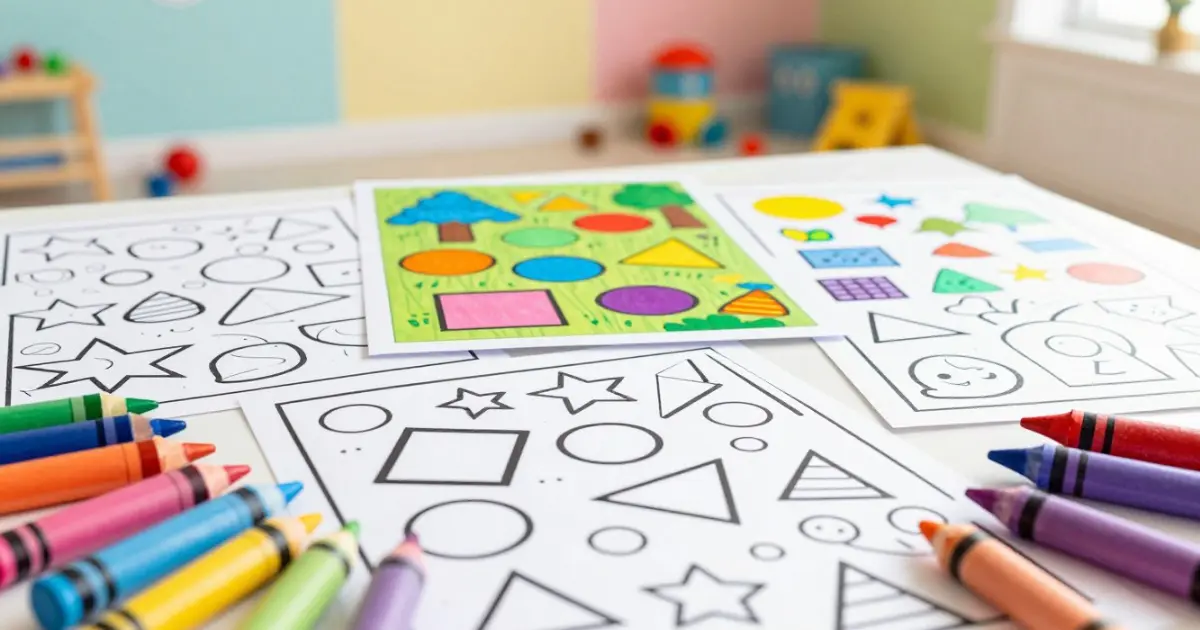
Simple sheets filled with outlines offer more than a creative outlet for your little artist. Using coloring pages to learn colors and shapes helps toddlers recognize visual patterns. These tools make identifying numbers plus geometry exciting for every curious learner.
Key Takeaways
- Enhances hue recognition.
- Improves fine motor skills.
- Teaches geometric forms.
- Builds number familiarity.
- Encourages focus.
- Prepares kids for school success.
How Coloring Pages to Learn Colors and Shapes Support Early Development
The use of educational coloring pages has been shown to support early development in children by enhancing their understanding of various concepts. These pages are not just a form of entertainment but a valuable educational tool.
Building Color Recognition Skills Through Repeated Exposure
Repeated exposure to different colors through coloring activities helps children develop their color recognition skills. As they color, they begin to distinguish between various hues and shades, laying the groundwork for more complex color theory understanding later on.
Color recognition games incorporated into coloring pages, such as matching colors or identifying objects by their color, further reinforce this learning.
Developing Shape Identification Abilities
Coloring pages that include various shapes help children develop their ability to identify and differentiate between these shapes. This skill is crucial for problem-solving and understanding more complex mathematical concepts in the future.
By coloring different shapes, children become familiar with the characteristics of each shape, such as the number of sides and angles.

Introducing Number Concepts Through Visual Learning
Visual learning through coloring can also introduce children to basic number concepts. For example, coloring pages that include numbers or require children to count objects before coloring them can help develop their numeracy skills.
| Concept | Learning Outcome | Example Activity |
|---|---|---|
| Color Recognition | Distinguish between different colors | Coloring pages with various colors |
| Shape Identification | Identify and differentiate shapes | Coloring pages featuring different shapes |
| Number Concepts | Understand basic numeracy | Coloring pages that include counting activities |
The Learning Benefits Your Child Gains from Educational Coloring Pages
Your child can gain numerous advantages from engaging with educational coloring pages, from improved fine motor skills to enhanced cognitive abilities. Educational coloring pages are not just a fun activity; they are a valuable tool in early childhood development.
Fine Motor Skills and Hand-Eye Coordination Development
Engaging with printable coloring sheets helps children develop their fine motor skills. As they color within the lines, they improve their hand-eye coordination and dexterity. This skill is crucial for future academic tasks such as writing and drawing.

Cognitive Development and Pattern Recognition
Educational coloring pages, especially those that involve shape identification worksheets, contribute to cognitive development. They help children recognize and understand different shapes, colors, and patterns. This enhanced understanding supports their ability to categorize and analyze information.
Memory Enhancement Through Repetition and Practice
Repetition is a key factor in learning, and coloring activities provide an engaging way to reinforce memory. By repeatedly coloring and recognizing shapes and colors, children enhance their memory retention. This is particularly beneficial when combined with preschool color activities that introduce new colors and shapes.
Problem-Solving and Decision-Making Skills
As children engage with educational coloring pages, they are presented with choices such as color selection and staying within the lines. These decisions help develop their problem-solving and decision-making skills. It’s an interactive way to learn and apply critical thinking.
Creating Positive Learning Associations and Confidence
Perhaps most importantly, educational coloring pages help create a positive association with learning. By enjoying the process of coloring, children build confidence in their abilities. This confidence can translate to other areas of their academic journey, making them more receptive to new challenges.
Conclusion
As you’ve seen, coloring pages offer a multifaceted tool for children’s learning and development, teaching colors, shapes, and numbers in an engaging and interactive way. By incorporating interactive coloring resources into your child’s daily routine, you can support their early development and lay the groundwork for future academic success.
These educational tools not only help children develop their fine motor skills and hand-eye coordination but also foster cognitive development and pattern recognition. By making learning fun, interactive coloring resources create positive associations and confidence in young learners.
You can easily integrate these valuable resources into your child’s learning routine, providing them with a strong foundation for future success. Explore the many interactive coloring resources available, and watch your child thrive as they learn and grow.
FAQ
How do coloring pages to learn colors and shapes benefit my child’s early development?
These pages provide a foundational visual experience that helps your child identify different hues and geometric forms through repeated exposure. By using educational coloring pages, you are helping your child build essential color recognition and shape identification skills in a stress-free, engaging environment.
Are printable coloring sheets effective for improving fine motor skills?
Yes, printable coloring sheets are excellent children’s learning activities for developing fine motor skills and hand-eye coordination. As your child maneuvers crayons or markers to stay within the lines, they strengthen the small muscles in their hands, which is a crucial precursor to handwriting and other manual tasks.
How do interactive coloring resources support cognitive growth and memory?
Interactive coloring resources and color recognition games encourage your child to engage in pattern recognition and problem-solving. This cognitive stimulation helps enhance memory enhancement through repetition, allowing your child to store and recall information about colors, shapes, and numbers more effectively.
Why should I incorporate shape identification worksheets into my child’s routine?
Shape identification worksheets serve as practical preschool color activities that bridge the gap between abstract concepts and visual reality. They allow your child to learn the properties of various shapes while reinforcing their ability to categorize information, which is a vital skill for early mathematics and logic.
Can educational coloring pages help my child learn numbers?
Definitely. Many educational coloring pages integrate visual learning by pairing numbers with a corresponding number of objects. This helps your child understand quantity and number concepts while they color, making the transition to formal math much smoother.
How do these activities foster positive learning associations and confidence?
When your child completes coloring pages to learn colors and shapes, they experience an immediate sense of accomplishment. These children’s learning activities allow for creative expression and decision-making, which builds your child’s confidence and fosters a lifelong love for learning through positive reinforcement.