
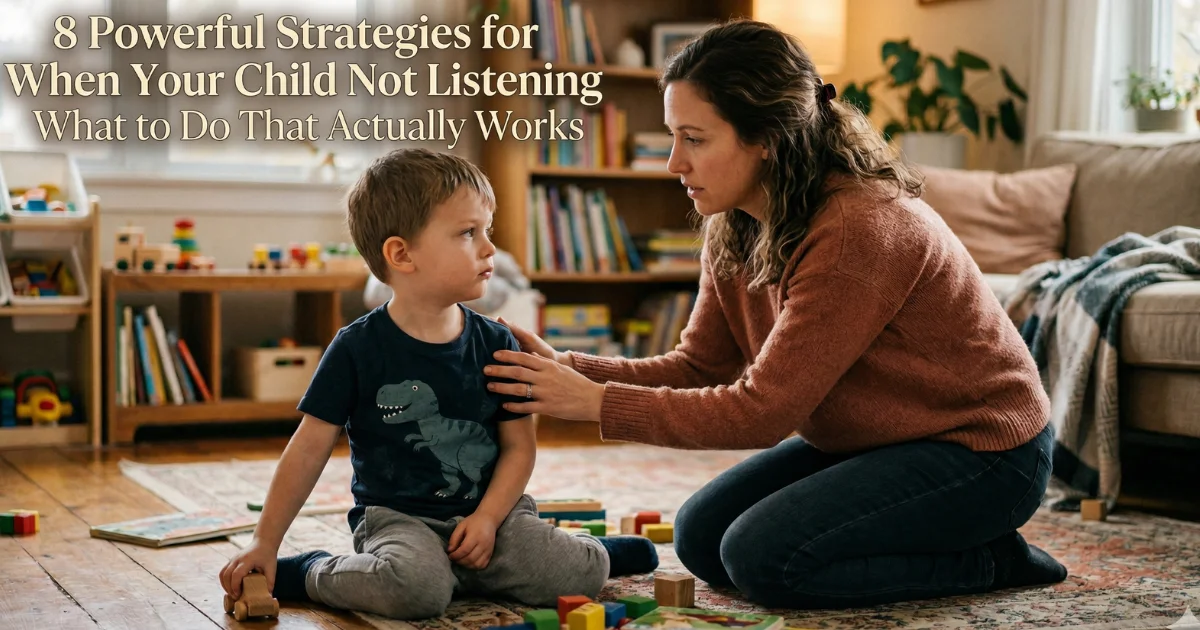
8 Powerful Strategies for When Your Child Not Listening What to Do That Actually Works
Table of Contents
8 Powerful Strategies for When Your Child Not Listening What to Do That Actually Works
Child not listening — what to do about it is one of the most common questions parents ask, and for good reason. Few things are more frustrating than repeating yourself five times only to be completely ignored. Whether your child tunes you out, talks back, or simply carries on as if you said nothing at all, this challenge can leave even the most patient parents feeling helpless and defeated.
The good news is that there are clear, research-backed reasons why children stop listening — and equally clear strategies to turn things around. This guide walks you through everything you need to know.
Why Your Child Is Not Listening — What to Do Starts With Understanding Why
Before jumping to solutions, it helps to understand what is actually happening when a child does not listen. In most cases, it is not defiance for the sake of defiance. There are usually specific developmental, emotional, or environmental reasons behind the behavior.
Developmentally normal behavior: Young children, especially toddlers and preschoolers, are still developing the brain structures responsible for impulse control and following instructions. The prefrontal cortex — the part of the brain that processes rules and consequences — is not fully developed until the mid-twenties. Expecting a four-year-old to consistently follow multi-step instructions is setting an unrealistic standard.
Seeking autonomy: As children grow, they develop a healthy need for independence. Resistance to parental instructions is often a sign of normal psychological development, not a character flaw.
Emotional flooding: When a child is overwhelmed, tired, hungry, or stressed, their capacity to process and follow instructions drops dramatically. A child in emotional distress literally cannot listen the way a calm child can.
Attention and connection needs: Sometimes children who are not getting enough positive attention will use non-compliance as a way to get their parent’s focus — even if that focus is negative.
Unclear or overloaded instructions: Adults often give instructions that are too long, too vague, or delivered at the wrong moment. “Get ready, clean your room, and stop fighting with your sister” is three instructions at once — no wonder it gets ignored.
Understanding the reason behind the behavior is the first step toward responding effectively.
8 Powerful Strategies: Child Not Listening — What to Do
1. Get Close Before You Speak
One of the most common mistakes parents make is issuing instructions from across the room while the child is engaged in something else. The instruction competes with whatever has their attention — and usually loses.
Instead, before speaking:
- Move close to your child physically.
- Get down to their eye level.
- Make gentle eye contact.
- Wait until you have their attention before giving the instruction.
This simple shift alone can dramatically increase how often your child actually hears and responds to what you say. It communicates respect and makes it much harder for them to genuinely not register your words.
2. Give One Clear Instruction at a Time
Children — especially young ones — can only hold a limited amount of information in working memory. A string of instructions delivered at once overwhelms that capacity and leads to partial or complete non-compliance.
Keep instructions simple and singular:
- Instead of “Get dressed, eat your breakfast, and pack your bag,” say “First, get dressed. Come find me when you’re done.”
- Use concrete, specific language: “Put your shoes by the front door” rather than “Get ready.”
- Avoid vague instructions like “behave” or “be good” — children need to know exactly what you want them to do.
After they complete the first task, give the next one. This approach takes more time in the short term but produces far better results than repeating a list of instructions five times.
3. Use Natural Consequences Instead of Empty Threats
Many parents fall into the cycle of repeating instructions and escalating threats that never materialize. “If you don’t come now, we’re not going to the party” — said four times, with the family still attending the party — teaches a child that your words have no weight.
Natural and logical consequences are far more effective:
- If they don’t put their shoes on when asked, they go out in their socks and experience the discomfort.
- If they don’t come to dinner when called, the food gets put away and they wait until the next meal.
- If they won’t turn off the game when asked, the device is unavailable the following day.
The key is to follow through consistently. A consequence delivered once and actually enforced is worth more than a hundred repeated threats.
4. Offer Controlled Choices
Resistance to instructions often comes from a child’s need for autonomy. Offering a controlled choice gives them a sense of agency while still moving toward the outcome you need.
Instead of: “Put your coat on now.”
Try: “Do you want to put your coat on before or after you put your shoes on?”
Instead of: “Come eat dinner.”
Try: “Do you want to sit on the red chair or the blue chair tonight?”
The choice is limited and both options lead to the same result — but the child feels heard and in control. This small shift reduces power struggles significantly.
5. Check Your Timing
Children are much less able to shift gears quickly than adults. Asking a child to stop an activity they are absorbed in and immediately do something else — without warning — is a recipe for resistance.
Use transition warnings:
- “In five minutes, we’re leaving. Start finishing up.”
- “When this episode is over, it’s bath time.”
- “You have time for one more game, then we’re switching off.”
Giving advance notice respects their engagement and gives their brain time to prepare for the transition. Most parents who start using this technique are genuinely surprised by how much smoother transitions become.
6. Examine the Relationship First
When a child consistently does not listen, it is worth asking a deeper question: How is the overall connection between us right now?
Children are far more cooperative with adults they feel connected to, seen by, and safe with. When the relationship is strained — perhaps due to a busy season of life, a stressful household environment, or a pattern of mostly corrective interactions — cooperation tends to drop.
Consider:
- Are you spending one-on-one enjoyable time with your child regularly?
- Is the majority of your interaction with them positive, or mostly corrective?
- Does your child feel heard and understood by you?
Increasing positive connection time — even 10 to 15 minutes of child-led play each day — often produces a noticeable improvement in cooperation within days. Children give their attention most freely to the people who give them theirs.
7. Stay Calm and Regulated Yourself
This is perhaps the hardest strategy and also one of the most important. When a parent becomes frustrated, raises their voice, or responds with anger to non-compliance, it almost always makes the situation worse. The child either shuts down, becomes defensive, or escalates in response to the emotional intensity.
Your nervous system has a direct effect on your child’s nervous system. When you remain calm, it literally helps your child regulate and become more receptive.
Practical ways to stay regulated:
- Take a slow breath before responding.
- Lower your voice rather than raising it — a quieter, firmer tone is often more effective than shouting.
- If you feel yourself about to lose control, pause: “I need a moment before I respond to this.”
- Remind yourself: “This is normal child behavior. I can handle this calmly.”
Responding calmly does not mean being passive or accepting non-compliance. It means addressing the behavior from a grounded, clear state rather than a reactive one.
8. Use Positive Reinforcement Intentionally
Parents often focus their attention on the moments when a child does not listen — and inadvertently ignore the many moments when they do. This creates a skewed dynamic where non-compliance gets the most parental attention.
Flip this around deliberately:
- When your child responds to a request promptly, notice it and name it specifically: “I asked you to come to dinner and you came right away — I really appreciate that.”
- Catch them being cooperative and make a point of acknowledging it warmly.
- Use a simple reward system for younger children — a sticker chart for following first-time instructions — to make compliance feel rewarding.
Over time, children learn that listening and cooperating gets them positive attention and acknowledgment. Non-compliance, by contrast, gets a calm, consistent consequence and nothing more.
Child Not Listening — What to Do Based on Age
The strategies above apply broadly, but here is how to adapt them by age:
Toddlers (1–3): Keep instructions to one step, use redirection frequently, offer physical help (“Let me help you put your shoes on”), stay warm and playful. Non-compliance at this age is almost always developmental — not deliberate defiance.
Preschoolers (3–5): Use choices and transition warnings consistently, make following instructions fun where possible, use simple logical consequences, keep routines predictable.
School age (6–12): Explain the reason behind requests, involve them in setting family rules and consequences, use natural consequences consistently, address the relationship if cooperation is consistently low.
Teenagers (13+): Shift from instructing to collaborating wherever possible, negotiate rather than demand, pick battles carefully, maintain the relationship as the top priority — connection is the most powerful driver of cooperation at this age.
When to Seek Support
Most challenges with a child not listening fall within the range of normal child development and respond well to the strategies above. However, there are situations where professional support may be helpful:
- Non-compliance is extreme, persistent, and not improving with consistent strategies.
- Your child’s behavior is significantly different from peers of the same age.
- There are signs of underlying anxiety, sensory processing challenges, or attention difficulties.
- The family is going through significant stress or change.
A child psychologist, family therapist, or your child’s pediatrician can help identify whether there is an underlying issue and recommend appropriate support.
Conclusion: Child Not Listening — What to Do Is Simpler Than You Think
Dealing with a child not listening is exhausting, but it is also one of the most solvable parenting challenges when approached with the right understanding and tools. The core message is this: most non-compliance is not about your child being bad or your parenting failing — it is about a developmental stage, an unmet need, or a communication mismatch that can be addressed.
Start with one or two strategies from this list — perhaps getting physically close before speaking and giving one clear instruction at a time. Practice them consistently for a week and notice the difference.
The relationship you build through calm, consistent, respectful communication is the most powerful tool you have. Children who feel genuinely connected to their parents — seen, heard, and loved — are also the children most likely to listen, cooperate, and thrive.
Looking for more practical parenting advice? Browse our blog for guides on child behavior, emotional development, and building strong family relationships.